What Is RAG (Retrieval-Augmented Generation)? A Plain-English Guide for 2026
Discover how Retrieval-Augmented Generation (RAG) grounds enterprise AI in your private business data to eliminate hallucinations, ensure security, and deliver accurate results.
When business leaders first experiment with large language models (LLMs) like GPT-4 or Claude, the initial reaction is usually excitement, quickly followed by hesitation. A CEO or CTO asks the model a question about their company’s fiscal policy, warehouse inventory, or internal warranty procedures, and the AI responds with confident nonsense. In the software industry, we call this hallucination. In enterprise operations, it is simply a liability.
The Core Problem: Why Base LLMs Struggle in Business
General-purpose language models are trained on massive archives of public internet data. While this gives them formidable language fluency and broad general knowledge, it comes with two fatal flaws for production business environments: a fixed knowledge cutoff date and zero access to your private company records.
A public LLM does not know your standard operating procedures, your real-time ERP pricing tables, or the specialized tax rulings issued by Pakistan's Federal Board of Revenue (FBR) last Tuesday. If you ask a raw foundation model to analyze internal technical documents, it must guess based on patterns in its public training set. In high-stakes sectors like finance, law, healthcare, and industrial supply chains, guessing is unacceptable.
What Is Retrieval-Augmented Generation (RAG)?
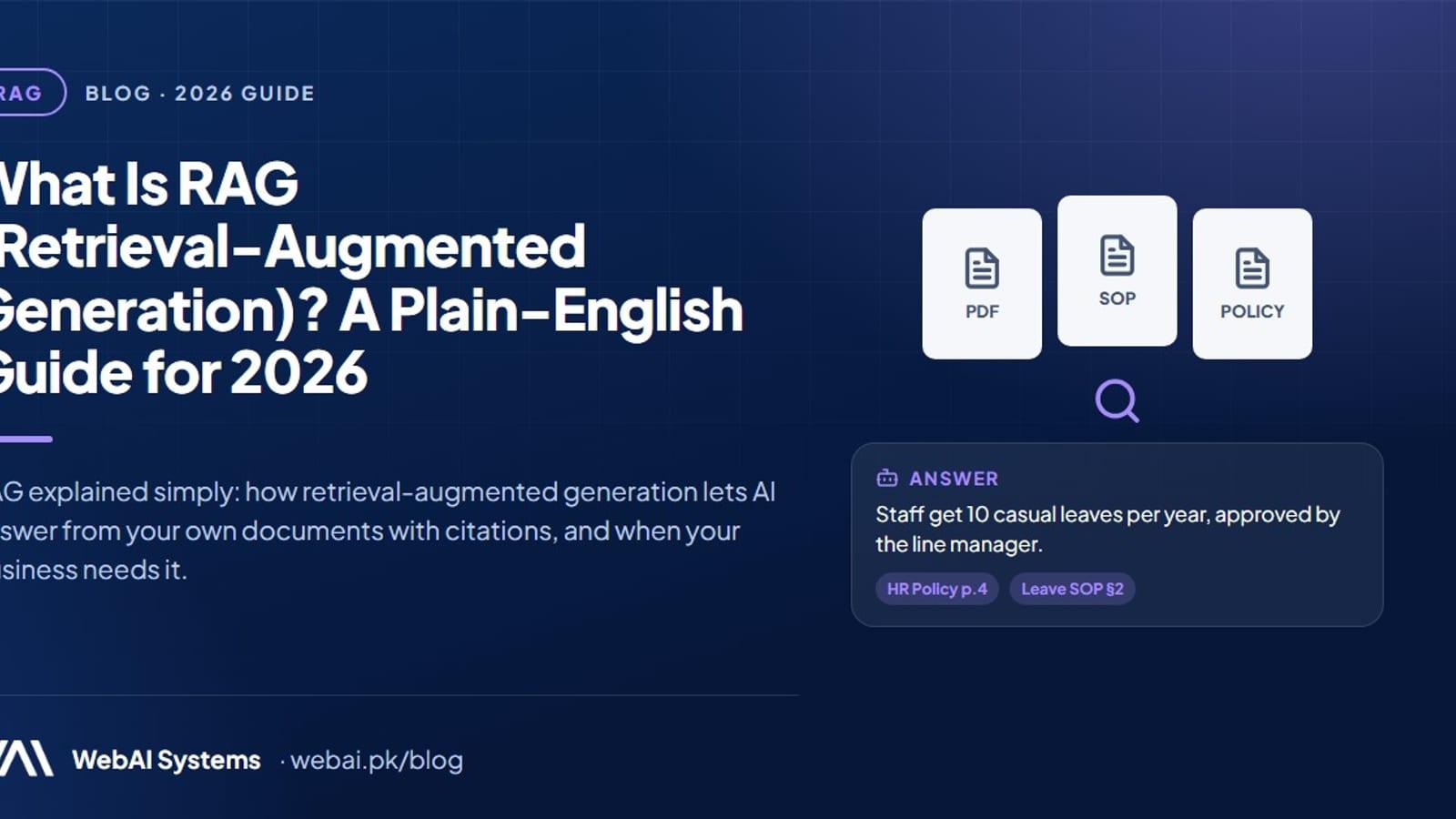
Retrieval-Augmented Generation, commonly known as RAG, is an enterprise AI architecture that connects an LLM directly to your verified internal data sources without retraining the model. Instead of relying solely on what the neural network memorized during training, RAG acts like an open-book exam for the AI.
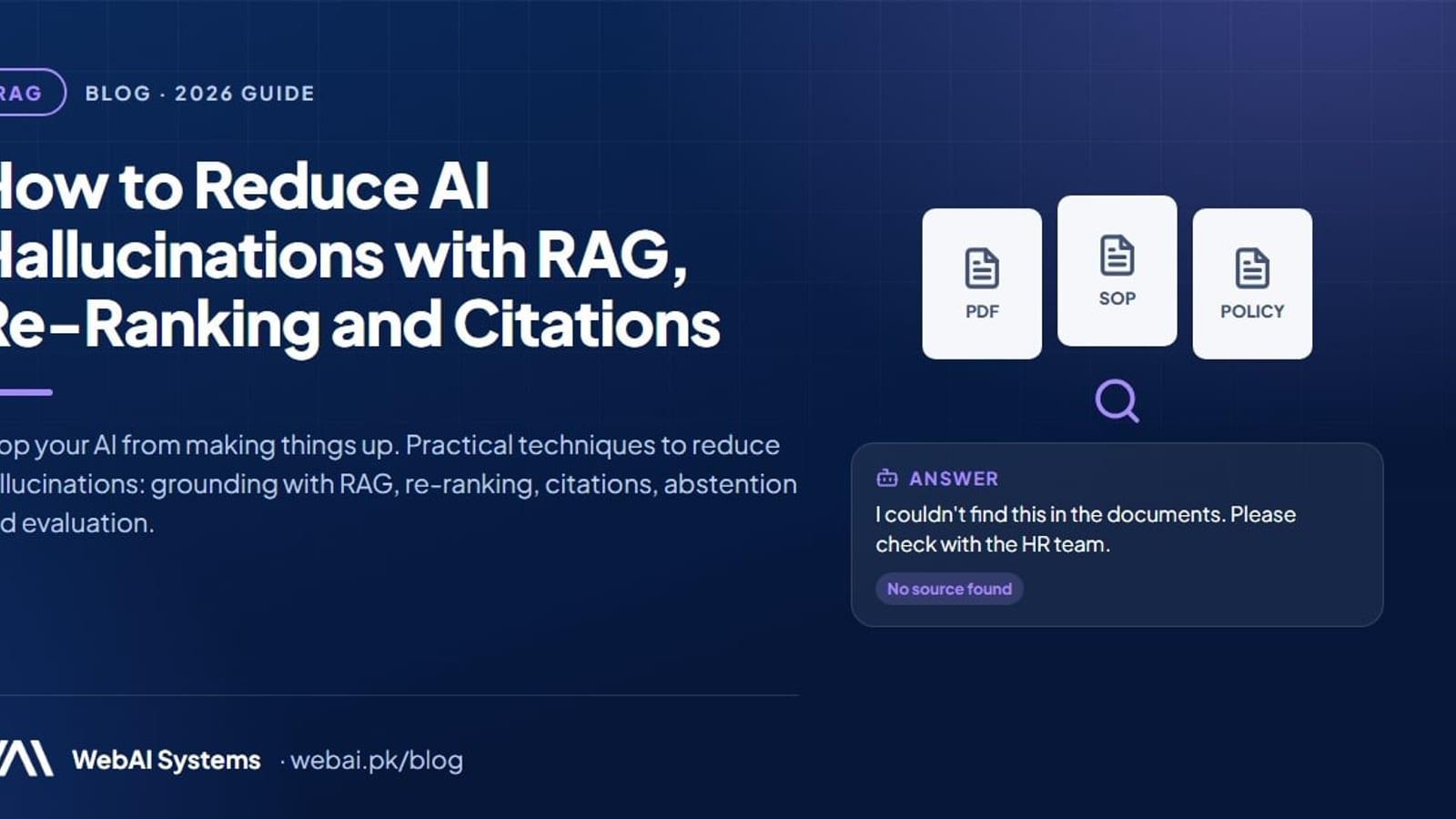
When a user submits an inquiry, the RAG system first searches your company's knowledge base—such as technical manuals, PDF contracts, SQL databases, or customer tickets—retrieves the exact text snippets relevant to the question, and feeds those snippets into the prompt. The LLM then reads those verified passages and writes a concise, coherent answer based exclusively on the facts provided.
How RAG Works: Step-by-Step Architecture
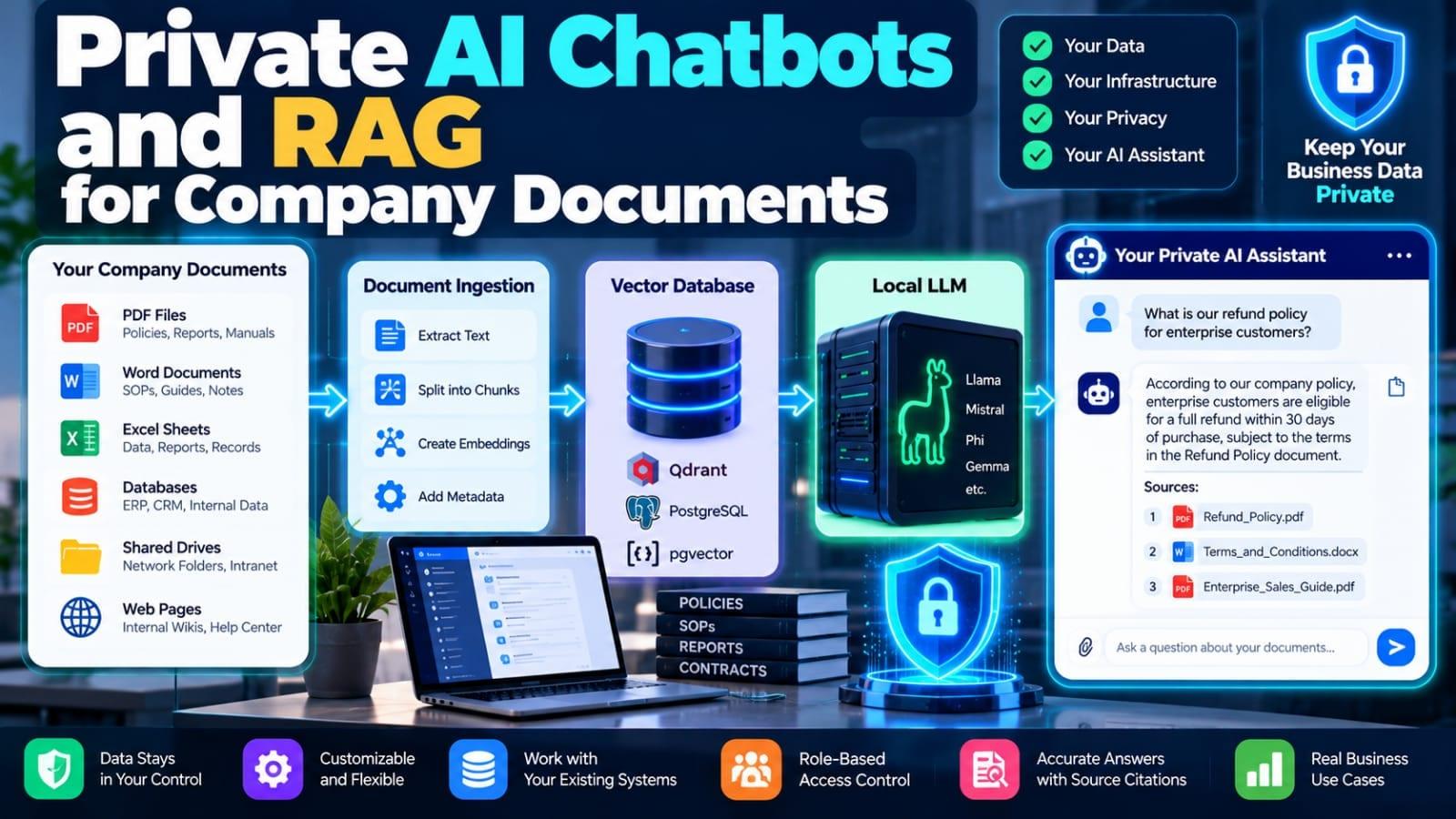
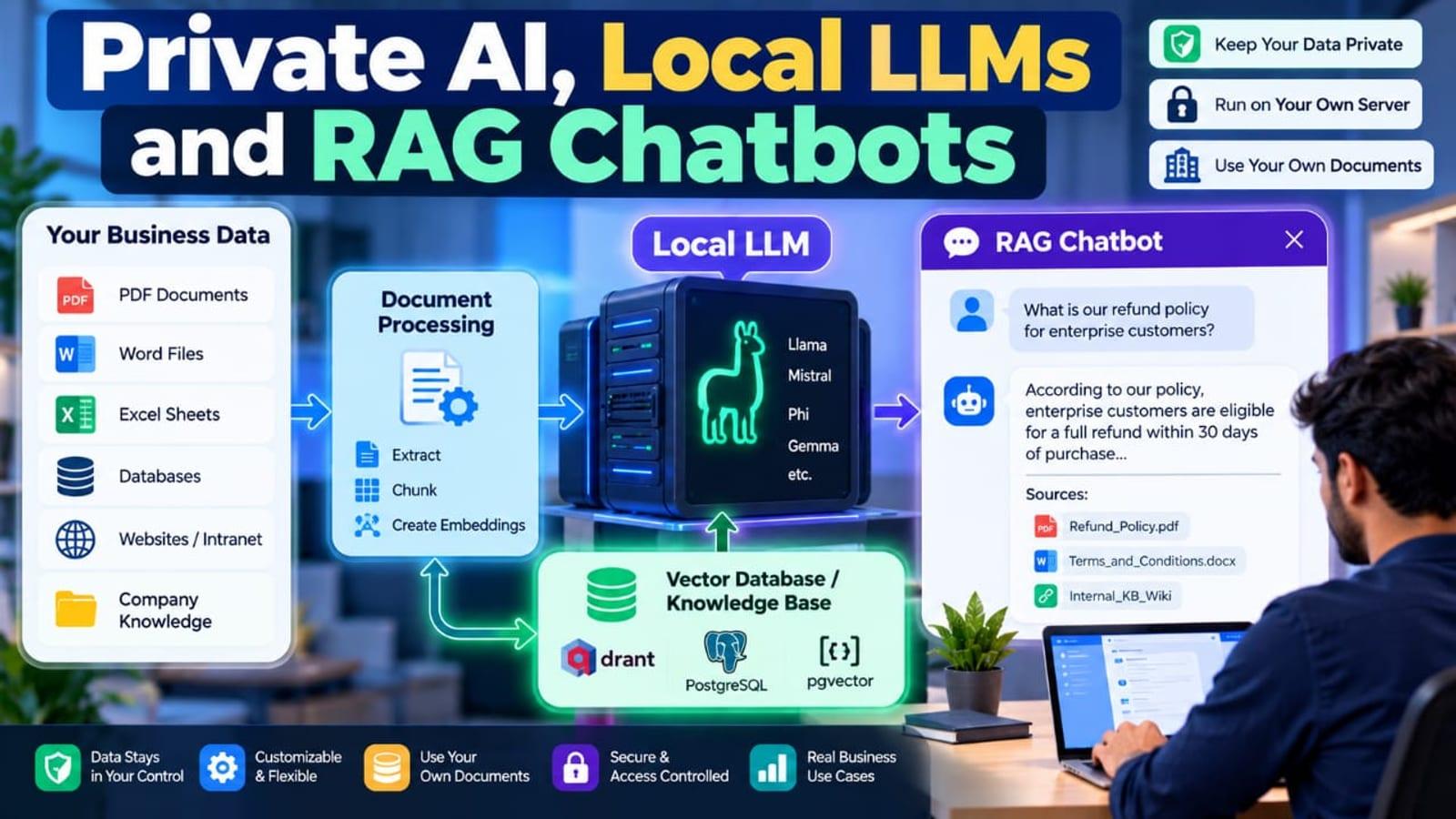
Behind the scenes, a production-grade RAG pipeline consists of two continuous phases: the data preparation phase and the runtime query phase.
1. Document Ingestion and Chunking
Your raw business documentation—whether stored in Google Drive, Notion, localized file servers, or legacy ERP exports—is parsed and broken into smaller, logical blocks of text called chunks. Proper chunking is critical: if a chunk is too short, it loses contextual meaning; if it is too long, it overwhelms the model with extraneous noise.
2. Vector Embedding and Storage
Each chunk passes through an embedding model that converts textual ideas into mathematical vectors (arrays of numbers). In vector space, sentences with similar meanings cluster together, regardless of exact keyword matches. These numerical representations are stored inside a specialized vector database, such as Qdrant, Pinecone, Milvus, or pgvector in PostgreSQL.
3. Semantic Retrieval
When an employee or customer asks a question, the RAG engine converts their question into a vector and performs a mathematical similarity search across the vector database. In milliseconds, the system identifies the top three to five chunks that contain the exact answers to the query.
4. Context Injection and Generation
The system constructs an augmented prompt containing system guardrails, the user question, and the retrieved chunks. The LLM receives instructions such as: "Answer the query using only the provided context. If the answer cannot be found, explicitly state that the information is unavailable." The model synthesizes the answer, citing specific pages or document IDs as verifiable references.
RAG vs. Fine-Tuning: Which One Do You Actually Need?
A common misconception among technical founders and business managers is assuming that teaching an AI about internal business documents requires "fine-tuning" the model. In practice, fine-tuning and RAG solve two entirely different operational problems.
- Fine-Tuning adjusts the internal weights of an LLM to alter its tone, stylistic output, or domain vocabulary (such as training a model to write code in a proprietary internal syntax or sound like a certified medical transcriptionist). Fine-tuning is costly, slow to update, prone to forgetting previous knowledge, and does not provide auditable source citations.
- RAG provides current, dynamic information. When your product catalog, shipping rates, or legal compliance terms change, you update the document in your repository. The vector database updates immediately, and every subsequent query reflects the new reality without spending thousands of dollars on GPU training cycles.
For 95% of business applications, RAG is faster to deploy, substantially cheaper to maintain, and fundamentally more auditable than fine-tuning.
What Changes for RAG in 2026?
Simple naive RAG—taking text, running top-k cosine similarity, and passing it to an LLM—is obsolete for mission-critical software. Modern deployments engineered by teams like WebAI Systems leverage more sophisticated paradigms:
Hybrid Search (Dense plus Sparse Retrieval)
Pure vector search excels at broad concepts but frequently fails on exact serial numbers, product codes, or customer identifiers. 2026 RAG pipelines combine semantic dense retrieval with BM25 sparse keyword matching, reranking candidates with a cross-encoder model to guarantee that exact product SKUs and legal clauses are retrieved reliably.
GraphRAG and Knowledge Graphs
Traditional vector chunking struggles with multi-hop questions, such as: "Which suppliers across Punjab supply textile components to our Faisalabad facility under contracts renewed in Q3?" GraphRAG builds structured knowledge graphs over unstructured text, linking entities, relationships, and temporal dependencies to answer complex organizational questions that vector similarity alone misses.
Agentic RAG Workflows
Instead of a single rigid search step, modern AI agents evaluate whether the retrieved context is sufficient. If the initial search yields incomplete information, the agent refines its search terms, queries secondary enterprise databases, runs verification routines, and synthesizes a multi-step answer.
Real-World Business Use Cases
RAG transforms static files into proactive operational intelligence across industries:
- Corporate Law and Tax Compliance: Law firms and corporate accounting practices in Pakistan use RAG to query decades of supreme court precedents, company acts, and evolving FBR circulars. Instead of associates spending six hours scanning PDF archives, the RAG engine summarizes applicable rulings in thirty seconds with pinpoint citations to the volume and page number.
- Custom ERP and Inventory Operations: Manufacturing enterprises connect RAG layers to their operational documentation and localized ERP systems. Floor managers ask natural-language questions regarding machine maintenance protocols, component availability, or historical repair logs directly via field tablets.
- Automated Customer Support over WhatsApp: By linking RAG pipelines directly to WhatsApp Business APIs, companies automate complex customer interactions. Prospective buyers receive instant, accurate answers regarding warranty clauses, shipping policies, and product specifications in English or Roman Urdu, grounded entirely in verified operational spreadsheets.
Implementing Enterprise RAG with WebAI Systems
Building a prototype RAG script takes an afternoon; deploying a secure, high-concurrency, hallucination-resistant RAG infrastructure demands rigorous software engineering. Data security, role-based access control (RBAC), chunking strategies, and token cost optimization separate lab demonstrations from production assets.
At WebAI Systems in Lahore, we design and deploy end-to-end RAG systems, autonomous AI agents, custom ERP integrations, and WhatsApp business workflows tailored for enterprises in Pakistan and across global markets. If your team is ready to turn scattered company documentation into an intelligent, secure, and searchable operational asset, we build the systems that make it happen.
- #rag
- #retrieval augmented generation
- #enterprise ai
- #vector database
- #ai agents