Reduce AI Hallucinations with RAG and Re-Ranking
Learn how to reduce AI hallucinations with RAG, re-ranking, and strict grounding techniques to build reliable enterprise knowledge systems.
When enterprise leaders deploy large language models, the most common roadblock is unreliability. Models hallucinate facts, invent product specifications, and cite non-existent documents with total confidence. If you want to reduce AI hallucinations with RAG (Retrieval-Augmented Generation), you need a robust architecture that goes beyond basic vector search. At WebAI Systems, we build production-grade knowledge retrieval systems for clients in Pakistan and globally. In this guide, we break down how to fix AI hallucinations by implementing vector search, cross-encoder re-ranking, and strict citation layers.
Why Base Large Language Models Fail in Production
Base LLMs are trained to predict the next token based on statistical probabilities, not to retrieve verified truths. When asked a specific question about internal company policies, pricing tiers, or proprietary codebases, a model will often extrapolate a plausible-sounding falsehood rather than admit ignorance. This happens because standard generation relies purely on parametric memory—the weights learned during pre-training.
To stop models from making things up, you must shift them from relying on parametric memory to utilizing non-parametric external memory. This is where Retrieval-Augmented Generation comes in. Instead of asking the model what it knows, you fetch relevant documentation from your database and inject it directly into the prompt context.
How to Reduce AI Hallucinations with RAG Architectures
Building a reliable RAG pipeline requires more than a simple embedding model and a vector database like Pinecone or pgvector. A naive RAG setup often fails because standard semantic search retrieves chunks that are superficially similar to the query but lack the specific contextual facts needed to answer it.
To successfully build reliable RAG systems, your data ingestion and retrieval pipeline must follow strict engineering practices:
- Semantic Chunking: Do not split documents by arbitrary character counts. Split them by logical sections, headers, and semantic boundaries to preserve context.
- Hybrid Search: Combine dense vector embeddings with sparse keyword search (such as BM25) to catch exact part numbers, acronyms, and proper nouns that vector models often miss.
- Metadata Filtering: Filter documents by tenant, department, or date before running similarity searches to reduce the noise pool.
Implementing RAG Re-Ranking and Citations
Retrieving the top fifty chunks from a vector database is only half the battle. Vector search uses bi-encoders, which embed the query and the document separately and compare them via cosine similarity. This is fast, but it sacrifices deep contextual understanding.
To truly prevent AI from making things up, you must introduce a cross-encoder re-ranker as a second-stage filter. A cross-encoder processes the query and the candidate document simultaneously, allowing the model to analyze deep linguistic interactions between the two.
- Initial Retrieval: Fetch the top 50 to 100 candidate chunks using hybrid vector search.
- Re-Ranking: Pass these candidates through a cross-encoder model (such as Cohere Rerank or BGE-Reranker) to score them based on precise relevance to the prompt.
- Context Pruning: Keep only the top 3 to 5 highest-scoring chunks and pass them to the LLM.
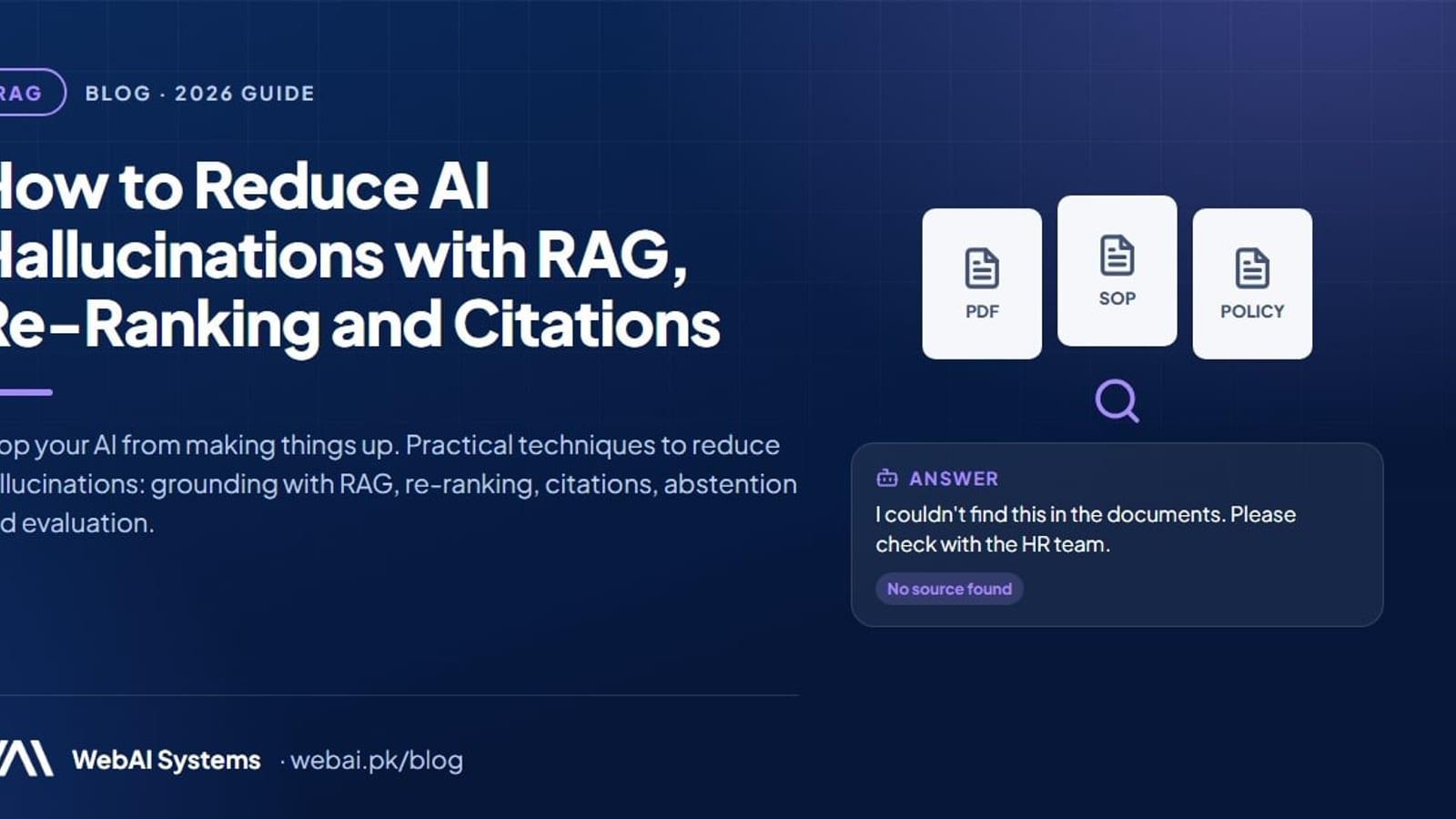
- Strict Citations: Force the generation prompt to output inline citations mapping directly back to the source document IDs. If the context does not contain the answer, instruct the model to return a fallback response.
Grounding LLMs with Enterprise Data
Grounding LLMs with enterprise data means treating your documents as the absolute source of truth. When building custom software or RAG knowledge systems for our clients, we enforce strict system prompts that penalize extrapolation. If an invoice, manual, or internal wiki does not explicitly state a fact, the AI is programmed to say: I cannot find this information in the provided documents.
Furthermore, caching and evaluation frameworks are essential. Tools like Ragas or TruLens allow you to programmatically measure faithfulness, answer relevance, and context recall. By running these evaluations in your CI/CD pipeline, you ensure that prompt updates or document additions do not quietly reintroduce hallucinations into your workflow.
Conclusion
Eliminating hallucinations is not about finding a magic model; it is about engineering a disciplined retrieval and verification pipeline. By combining hybrid search, cross-encoder re-ranking, and strict prompt constraints, you can deploy AI agents and knowledge systems that your team and your customers can actually trust. Ready to build a production-ready RAG system for your enterprise? Contact WebAI Systems today to discuss your custom AI architecture requirements.
- #rag
- #ai hallucinations
- #re-ranking
- #vector database
- #llm grounding