Private AI and Local LLMs: On-Premise Enterprise RAG
Deploying on-premise LLMs and private RAG chatbots gives enterprises full data sovereignty, zero leakage risks, and predictable infrastructure costs.
When companies began integrating generative AI into everyday workflows, the default path was simple: connect to an API endpoint provided by OpenAI, Anthropic, or Microsoft Azure. For consumer customer support and non-critical summarization, public cloud APIs remain functional. However, for organizations managing sensitive financial ledgers, proprietary manufacturing schematics, medical records, or classified government contracts, sending internal knowledge across public networks introduces untenable regulatory and operational risks.
Data leaks via chat interfaces, compliance violations under data sovereignty mandates, and unpredictable token consumption bills have forced enterprise technical decision-makers to pivot. The solution is Private AI: hosting local Large Language Models (LLMs) connected to Retrieval-Augmented Generation (RAG) pipelines inside a company’s own virtual private cloud (VPC) or bare-metal data center.
The Core Drivers: Why Public Cloud APIs Fail the Enterprise Test
Enterprise IT directors and Chief Information Security Officers (CISOs) face strict boundaries regarding third-party vendors. Several non-negotiable hurdles prevent enterprise adoption of commercial cloud LLMs:
- Data Sovereignty and Compliance: In Pakistan, financial institutions must adhere to State Bank of Pakistan (SBP) cybersecurity directives and data protection guidelines prohibiting customer transaction records from leaving national borders or residing on shared multitenant infrastructure. Similar compliance mandates exist worldwide via GDPR, HIPAA, and SOC 2 Type II frameworks.
- IP and Trade Secret Protection: Uploading proprietary source code, internal legal contracts, or undisclosed patent filings to third-party model providers risks exposure through account breaches or accidental inclusion in future model training runs.
- Vendor Lock-in and API Deprecation: Commercial LLM vendors routinely deprecate model versions, modify system prompt behaviors, or experience service outages. When mission-critical core ERP logic or automated ticketing relies on an external API, downtime directly impacts revenue.
- Uncapped Token Operational Expenses: High-volume business operations—such as analyzing tens of thousands of PDF invoices, technical logs, or customer WhatsApp interactions daily—cause metered token pricing to compound exponentially compared to fixed hardware infrastructure.
The Mechanics of a Local RAG Architecture
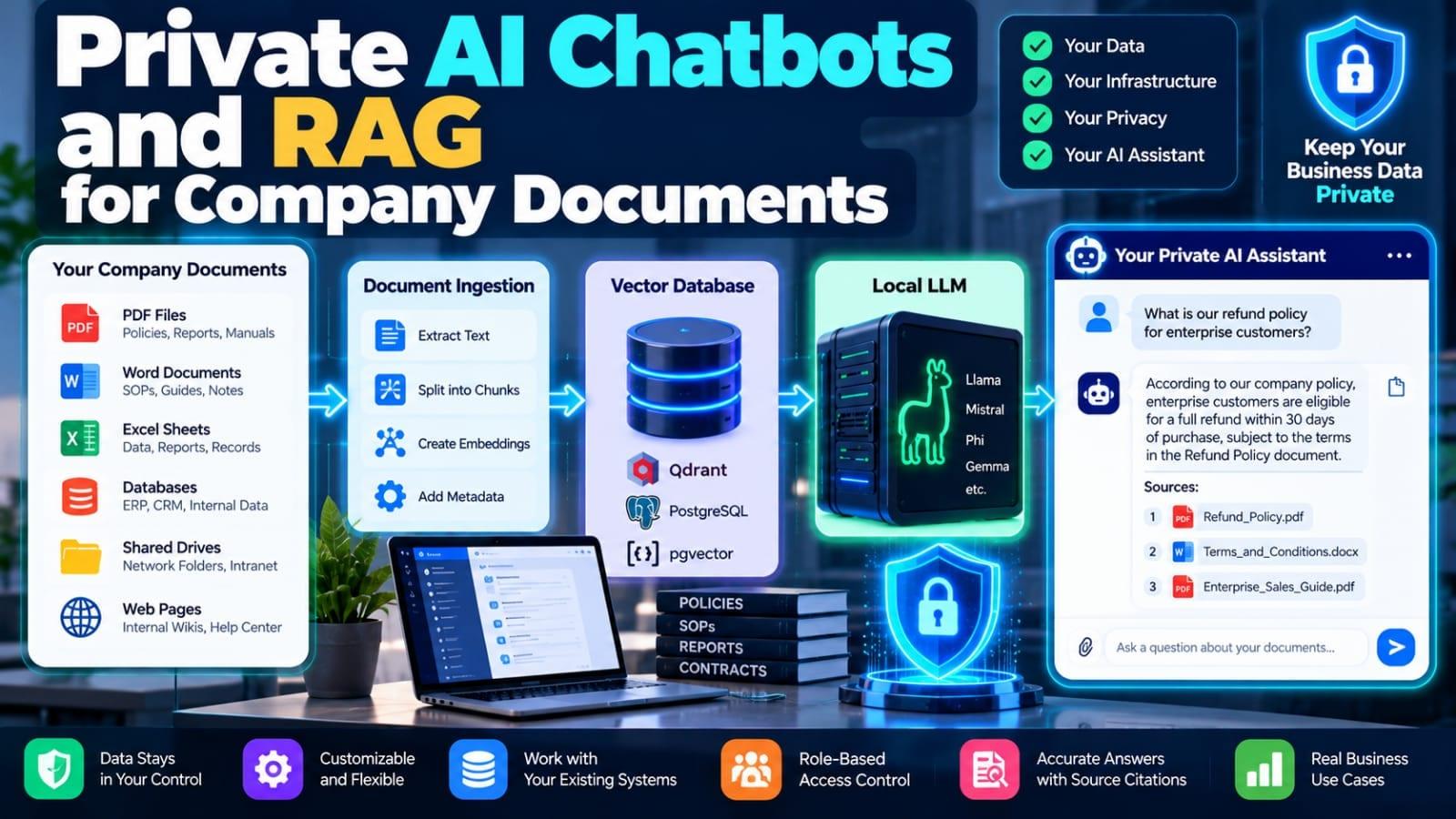
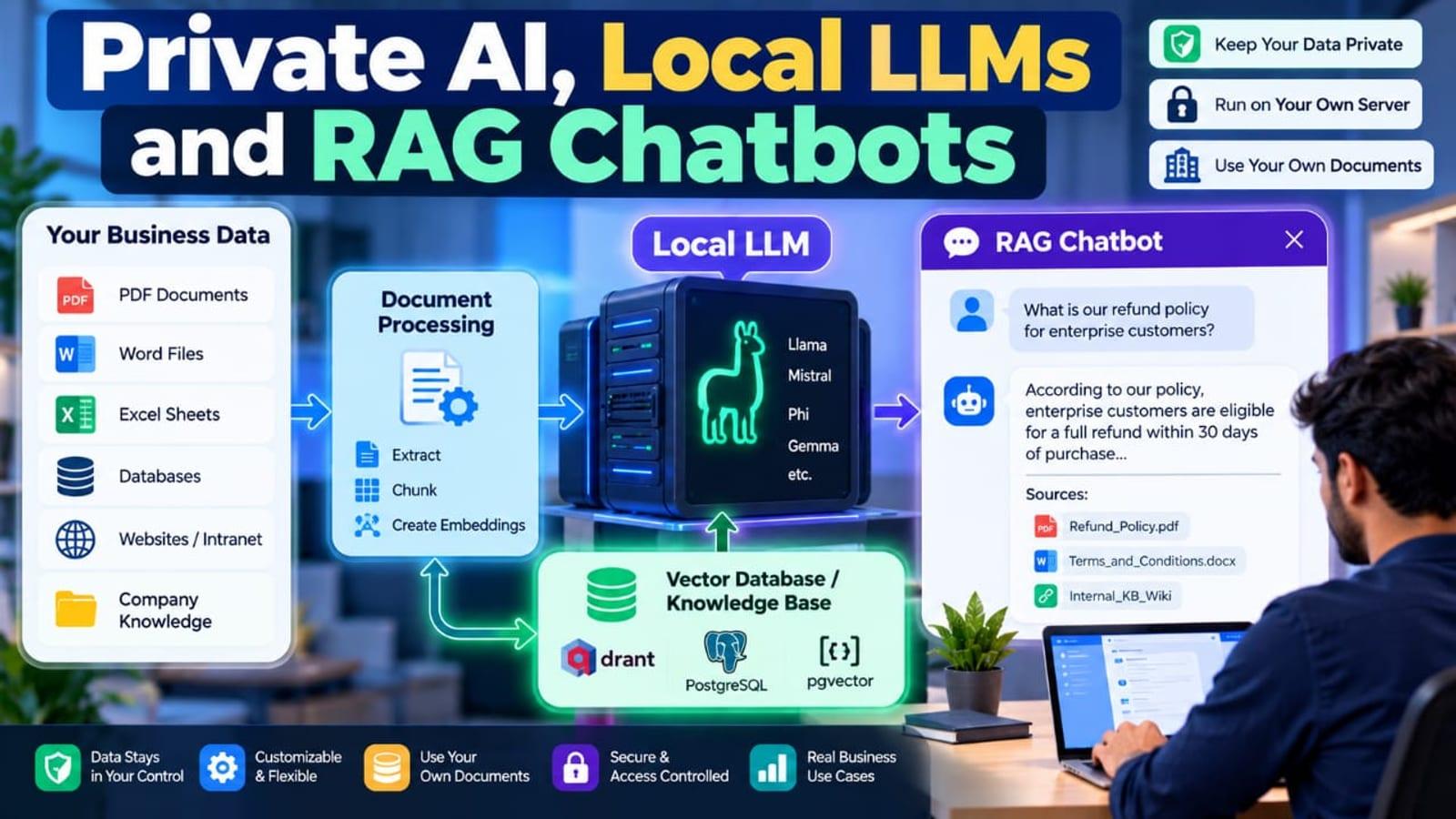
A private RAG chatbot does not simply replace ChatGPT with an offline desktop application; it orchestrates an enterprise-grade stack capable of fast ingestion, deterministic retrieval, and air-gapped inference. A production-ready local RAG deployment contains four discrete components:
1. Document Ingestion and Chunking Pipelines
Internal enterprise data is messy, consisting of scanned PDFs, Excel workbooks, ERP SQL databases, Confluence wikis, and scanned Urdu and English paperwork. A private pipeline extracts clean text, strips metadata, and chunks information semantically rather than relying on arbitrary character limits. Preserving table structures, headers, and document hierarchy ensures the model retrieves complete factual contexts rather than fragmented sentence pieces.
2. Self-Hosted Embedding Models
Before text can be searched, it must be converted into numerical vector representations. Instead of pinging cloud embedding endpoints, organizations run high-performance open-source embedding models locally. Architectures like BAAI BGE-M3 or Nomic Embed can run efficiently on standard CPU or entry-level GPU instances, generating dense vector embeddings while keeping all textual data inside the secure perimeter.
3. The Vector Database Layer
Extracted embeddings are indexed in dedicated, self-hosted vector databases such as Qdrant, Milvus, or the pgvector extension within an existing PostgreSQL instance. This database performs sub-second approximate nearest neighbor (ANN) searches across millions of document chunks. Modern private setups leverage hybrid search, combining dense semantic search with sparse keyword search (BM25) to ensure exact terms—like part numbers, invoice IDs, and legal clauses—are retrieved without semantic drift.
4. Local LLM Inference Engines
Once relevant contextual snippets are retrieved, they are injected into an prompt sent to an on-premise LLM. Utilizing advanced inference engines like vLLM, TensorRT-LLM, or TGI (Text Generation Inference), businesses achieve enterprise-grade throughput and concurrent request handling. High-capability open-weight models, such as Meta’s Llama 3 family, Mistral Nemo, and Alibaba’s Qwen 2.5, match or exceed previous proprietary flagship models on domain-specific enterprise knowledge extraction.
Hardware and Infrastructure: Sizing Local Deployments
A recurring misconception is that running local AI requires massive compute clusters costing hundreds of thousands of dollars. Thanks to advancements in 4-bit and 8-bit quantization formats (such as AWQ, GPTQ, and GGUF), resource requirements have dropped significantly:
- Small Enterprise Pilot (Under 50 Concurrent Users): A single high-end workstation or server equipped with an NVIDIA RTX 4090 (24GB VRAM) can comfortably run an 8B or 14B parameter model quantized to 4-bit, alongside local embedding generation, delivering 40 to 60 tokens per second.
- Mid-Tier Corporate Deployment (50 to 500 Concurrent Users): Dual NVIDIA RTX 6000 Ada generation GPUs or dual NVIDIA A100 (80GB) cards allow organizations to run Llama 3.3 70B in 4-bit or 8-bit precision. This provides the reasoning power required for complex legal, clinical, and financial analysis across dozens of simultaneous threads.
- Air-Gapped Institutional Datacenter: For defense, government, or high-throughput banking infrastructures, clusters powered by four to eight NVIDIA H100 or L40S accelerators handle massive scale, distributed document indexing, and microsecond-level vector search without any inbound or outbound internet access.
Implementing Role-Based Access Control (RBAC) in Private RAG
The single greatest operational challenge in enterprise knowledge retrieval is authorization. If an executive asks a RAG bot about executive compensation or Q4 restructuring plans, the system should answer accurately. If an entry-level clerk submits the same query, the bot must not reveal restricted documents.
Public AI services treat all vectorized data identically unless complex application logic is wrapped around them. In a private WebAI Systems RAG deployment, document vectors inherit permissions directly from Active Directory, LDAP, or ERP user roles. Retrieval queries automatically filter database search results by user access tokens before the context ever reaches the local LLM. If the user lacks clearance for Document X, the embeddings for Document X are excluded from the mathematical search space entirely. Hallucination or leak of unauthorized data becomes mathematically impossible.
Practical Enterprise Scenarios
Organizations across South Asia and global markets are operationalizing private AI architectures in practical ways:
- Textile and Manufacturing Operations: Running on-premise RAG bots connected to custom ERPs and maintenance manuals. Machine technicians query industrial machinery documentation via local terminals to troubleshoot equipment without depending on unstable internet links on factory floors.
- Commercial Banking and Fintech: Internal compliance agents query thousands of pages of anti-money laundering (AML) regulations, transaction audits, and credit sanction manuals locally, with 100% adherence to regional banking secrecy laws.
- Hospital Networks: Clinical assistants parse patient discharge summaries, diagnostic laboratory results, and pharmaceutical formularies securely within local hospital networks, eliminating HIPAA and patient privacy liability.
Building Your Sovereign AI Infrastructure
Relying on public cloud LLMs for sensitive business logic is an unnecessary technical and legal liability. Open-weight language models, coupled with local vector retrieval, now deliver accuracy, low latency, and deterministic grounding rivaling proprietary web platforms—while preserving complete corporate control.
WebAI Systems designs, deploys, and maintains end-to-end private AI solutions, ranging from bare-metal hardware procurement and quantization tuning to custom on-premise RAG chatbots integrated into your ERP and internal communication channels. Securing your enterprise data does not mean forgoing the productivity of generative intelligence; it means owning the infrastructure behind it.
- #private ai
- #local llm
- #rag
- #data sovereignty
- #enterprise ai
- #information security