Private AI Chatbots and RAG for Company Documents
Learn how private Retrieval-Augmented Generation (RAG) chatbots let enterprises query sensitive internal documents securely, eliminate hallucinations, and enforce strict access controls.
Every established business runs on an ocean of proprietary documentation: standard operating procedures, vendor contracts, internal HR policies, technical runbooks, ERP export files, and board meeting minutes. Yet, when an employee needs a specific answer—such as an export duty calculation formula, an SLA clause in a legacy contract, or a troubleshooting step for a textile milling line—they spend forty minutes digging through shared drives or messaging colleagues on Slack.
Public generative AI tools like ChatGPT solved the conversational interface problem, but they introduced two unacceptable risks for enterprise use: zero data privacy and frequent hallucinations. Pasting confidential company data into cloud models often violates non-disclosure agreements, data sovereignty regulations, and internal security policies. Retrieval-Augmented Generation (RAG) combined with private AI infrastructure solves both challenges, transforming static company documentation into an intelligent, auditable internal search and automation system.
What Is Retrieval-Augmented Generation (RAG)?
Large Language Models (LLMs) operate solely on the data they were trained on. They do not know what changes occurred in your company yesterday, nor do they know your proprietary formulas. When asked about facts outside their training weights, they guess—producing hallucinations with absolute linguistic confidence.
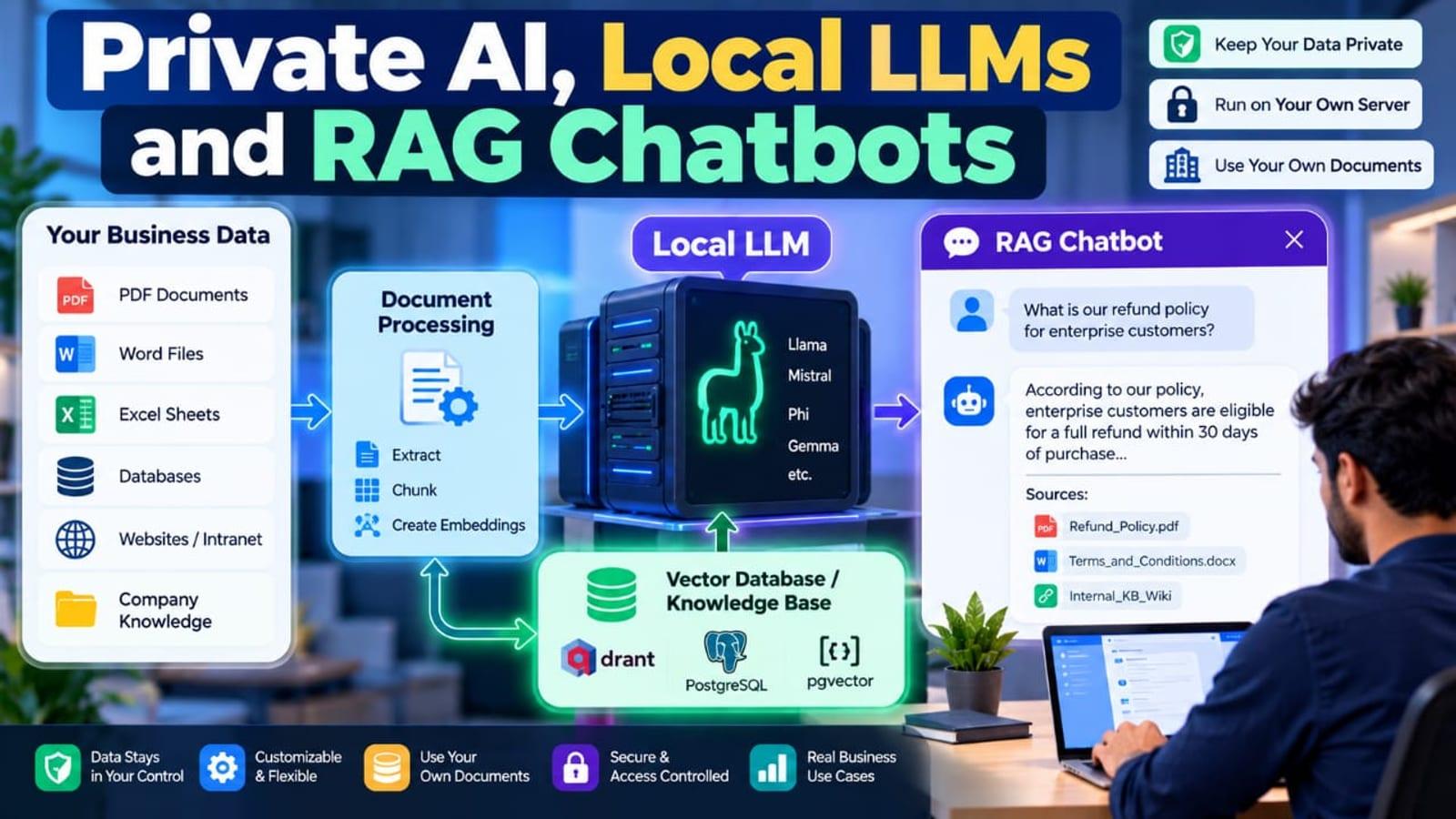
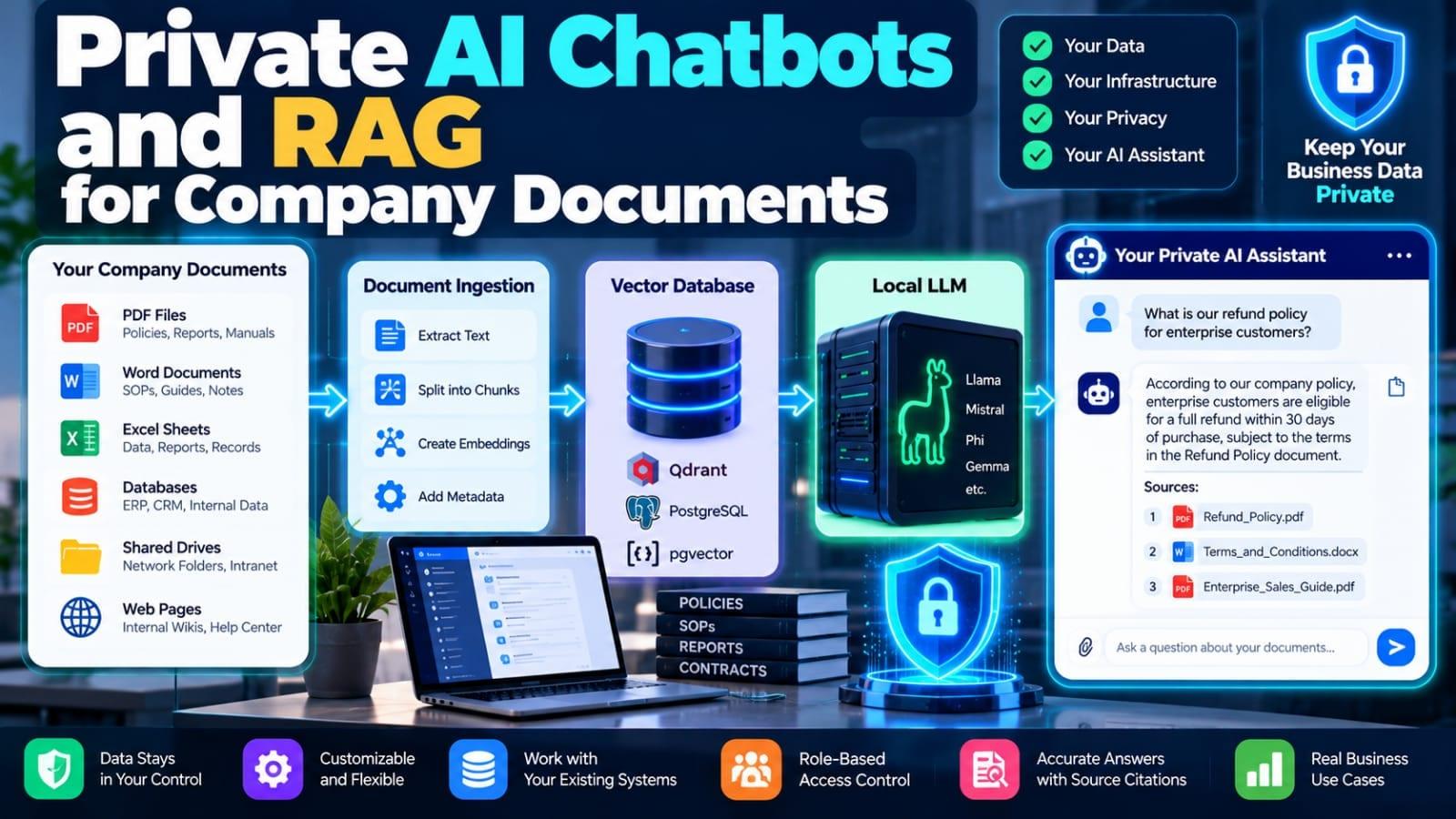
RAG eliminates this guesswork by decoupling intelligence from memory. Instead of forcing an LLM to memorize enterprise files, RAG treats the model as an analytical engine that processes retrieved facts. When an employee asks a question, the RAG system executes a multi-step sequence:
- Document Ingestion: Company files (PDFs, Word documents, Markdown sheets, ERP exports, and scanned records) are parsed, cleaned, and split into semantic chunks.
- Vector Embedding: Each chunk is converted into a high-dimensional mathematical vector that captures its semantic meaning using an embedding model.
- Vector Indexing: These embeddings are stored in a high-speed vector database such as Qdrant, Milvus, or PostgreSQL with pgvector.
- Semantic Retrieval: When a user enters a query, the query is embedded and compared against the database to retrieve only the 3 to 5 most relevant document chunks.
- Grounded Synthesis: The retrieved text is passed into a private LLM alongside the user prompt, with strict system instructions: Answer using only the provided context. If the answer is not in the text, state that clearly. Cite the exact page or section.
Why Privacy Is the First Hurdle for Enterprise AI
Deploying AI inside a business cannot happen at the expense of client confidentiality, legal privilege, or regulatory compliance. For Pakistani companies working with international clients or governed by local entities like the State Bank of Pakistan (SBP) and the Federal Board of Revenue (FBR), sending financial spreadsheets or client records to external cloud endpoints is an immediate compliance violation. International firms face strict penalties under GDPR, HIPAA, and SOC 2 frameworks.
A private RAG architecture eliminates this exposure through two main deployment patterns:
1. Fully On-Premises or Private Cloud Hosting
By hosting open-weights foundation models—such as Meta's Llama 3.3 or Mistral—on dedicated enterprise infrastructure using inference frameworks like vLLM or Ollama, zero data packets leave your corporate firewall. The embedding engine, vector database, and inference servers live inside your own Virtual Private Cloud (VPC) on AWS, Azure, GCP, or on bare-metal GPU servers situated in your local data center.
2. Zero-Data-Retention Enterprise Endpoints
If managed cloud models like Azure OpenAI or AWS Bedrock are selected, enterprise agreements must guarantee zero data retention. Your prompts, embeddings, and context are explicitly excluded from model training cycles and stored only in temporary memory during inference.
Core Architectural Components of a Secure Company RAG
A production-ready RAG application is substantially more sophisticated than a weekend open-source wrapper. Moving a document bot from a proof of concept to a daily operational tool requires solving difficult data-engineering challenges.
Role-Based Access Control (RBAC)
Not every employee should have access to every document. An intern asking about compensation benchmarks should not receive answers extracted from executive payroll sheets. WebAI Systems implements metadata-level filtering directly inside the retrieval layer. When a user authenticates via your Active Directory, Okta, or Google Workspace, their security tokens and department roles are attached to the search vector. The vector engine only queries documents tagged with matching permissions, preventing data leakage before the LLM ever sees the prompt.
Hybrid Search and Re-Ranking
Vector search excels at understanding semantic concepts, but it often struggles with exact alpha-numeric strings like product SKUs, tax identification codes, ticket numbers, or chemical batch formulas. Enterprise implementations utilize hybrid search: combining dense vector retrieval with lexical keyword search (BM25). The combined candidates pass through a cross-encoder re-ranking model (such as BGE-Reranker) to score and sort the most relevant paragraphs before building the prompt context.
Document Parsing and OCR for Legacy Records
Real enterprise documentation is rarely clean text. It contains nested tables, scanned contracts with stamps, complex diagrams, and multi-column invoices. Using basic text scrapers breaks table relationships, causing the AI to misunderstand row-and-column connections. Production pipelines require dedicated vision-assisted document layout parsers and local OCR models to transform scanned PDFs and tables into structured Markdown tables prior to vectorization.
Real-World Enterprise Applications
Organizations across multiple sectors deploy private RAG systems to solve specific operational bottlenecks:
- Textile and Manufacturing Plants: Factory floor supervisors search thousands of pages of equipment manuals, compliance certifications, and maintenance logs in real time. Instead of halting a machine for hours, the technician queries the chatbot to isolate error codes and review repair steps immediately.
- Customs and Logistics Operators: Freight forwarders query changing HS code classifications, customs clearing circulars, and bilateral shipping agreements without manually leafing through federal regulatory gazettes.
- Software Development Teams: Engineering teams search internal API documentation, infrastructure architecture diagrams, and private Git repositories to speed up new developer onboarding and cut redundant internal code generation.
- Corporate Legal and Procurement: Legal teams compare historical supplier contracts, verifying indemnification clauses, payment cycles, and penalty thresholds across fifteen years of archived vendor relationships in seconds.
Avoiding the Common Traps in Document AI
Building an effective enterprise chatbot requires avoiding typical engineering traps. One common mistake is chunking text blindly by character count. Splitting a document every 500 characters often cuts a legal clause or financial table in half, destroying the contextual meaning. Semantic chunking—breaking text by section headings, paragraphs, or semantic boundaries—preserves context.
Another failure point is neglecting evaluation benchmarks. Without automated evaluation frameworks like Ragas or TruLens, engineering teams cannot measure whether a model update improves or degrades context precision, factual groundedness, and answer relevancy. Enterprise systems must continuously monitor response latency, retrieval recall, and query telemetry.
Building Enterprise RAG with WebAI Systems
At WebAI Systems, we design, build, and deploy production-grade AI agents and private RAG architectures tailored to enterprise infrastructure. Based in Lahore and delivering solutions globally, our engineering team ensures that your data pipelines, vector indices, and inference layers remain secure, compliant, and integrated into your daily workflow—whether through custom web interfaces, ERP integration, or automated WhatsApp endpoints.
If your organization is ready to stop wasting billable hours on manual document searches and harness the power of private internal AI, contact WebAI Systems today to schedule a technical architecture consultation.
- #rag
- #private ai
- #enterprise ai
- #vector search
- #document automation
- #data security