
Blog · AI
Artificial General Intelligence: An Enterprise Reality Check
Move past the sci-fi speculation. Here is what Artificial General Intelligence means for enterprise software architecture, data readiness, and automation today.
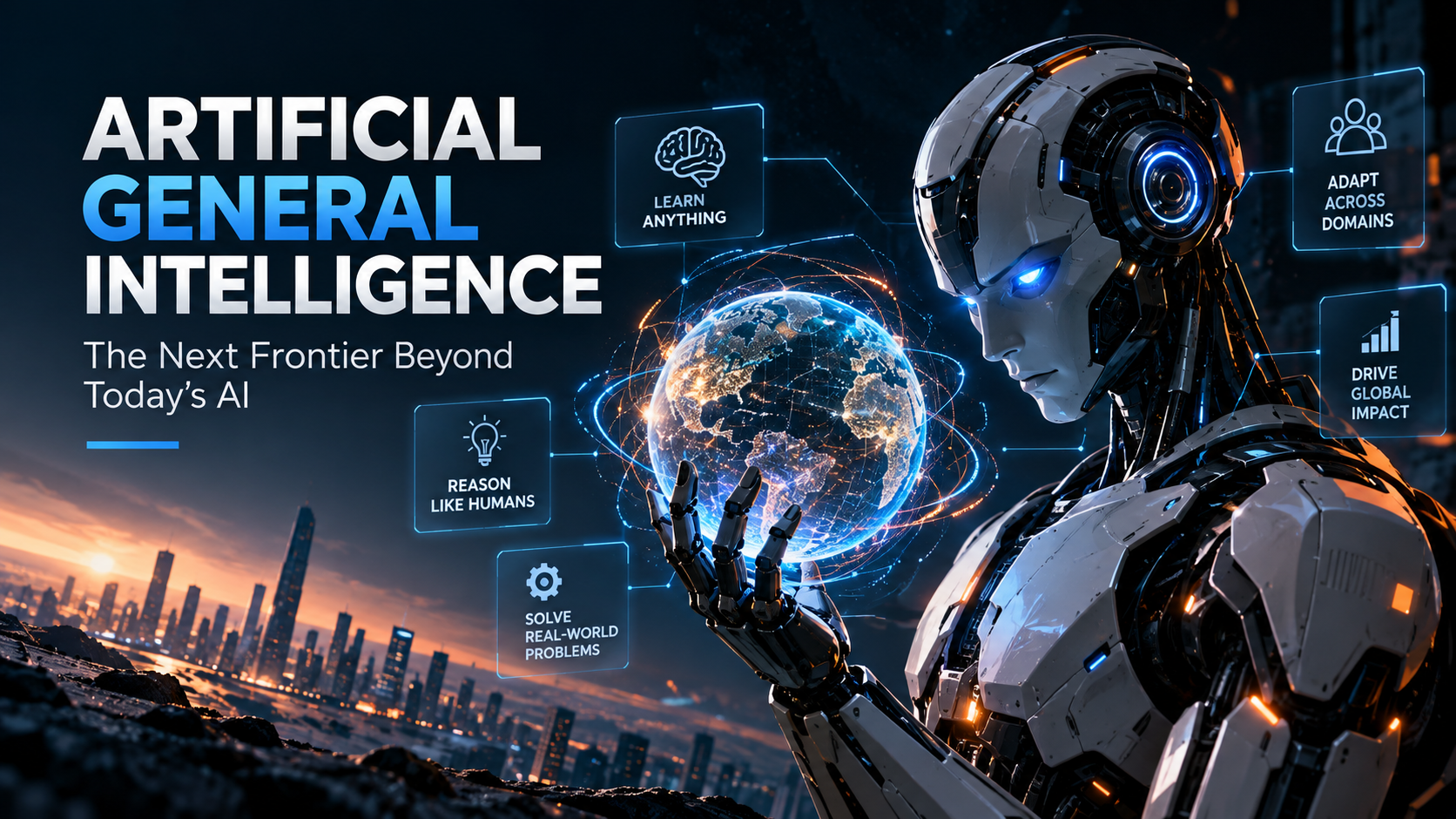
Artificial General Intelligence (AGI) dominates academic research papers and venture capital keynotes, but the conversation among chief technology officers and operational leaders requires a different lens. While theorists debate when a synthetic system will achieve human-level cross-domain reasoning, commercial enterprises must solve immediate efficiency bottlenecks. Waiting for a generalized super-intelligence to magically fix disorganized business operations is a recipe for obsolescence. The practical question is not whether AGI will arrive in three years or thirty, but how the underlying architectural shift—from rigid software scripts to autonomous, reasoning systems—transforms business infrastructure today.
Defining AGI Beyond the Science Fiction Trope
In academic literature, Artificial General Intelligence refers to a software system capable of understanding, learning, and applying knowledge across disparate domains with the adaptability and autonomy of a human professional. Unlike narrow AI, which excels at isolated tasks like detecting invoice anomalies or transcribing customer calls, an AGI system could theoretically evaluate a regional supply chain disruption, renegotiate freight contracts, reconfigure warehouse management software, and update financial forecasts without manual intervention.
For enterprise decision-makers, debating the philosophical consciousness of machines is an unproductive distraction. In a commercial context, AGI represents the convergence of three foundational capabilities:
- Cross-domain contextual reasoning: The ability to take institutional knowledge learned in one department (such as legal compliance) and apply it logically to another (such as vendor procurement).
- Autonomous tool orchestration: The capacity to autonomously select, call, and verify data across APIs, SQL databases, ERP systems, and communication channels without explicit conditional code paths.
- Long-horizon planning and self-correction: The capability to execute multi-step workflows, detect runtime errors, rollback faulty database entries, and re-attempt execution until a verified outcome is achieved.
The Real Bridge to AGI: Autonomous AI Agents
True AGI does not emerge overnight from a single frontier model checkpoint. Instead, enterprises are bridging the gap through agentic AI architectures. Rather than interacting with large language models through static chat prompts, businesses are deploying multi-agent systems designed around specific roles, planning loops, and programmatic tool execution.
Consider an enterprise manufacturing company operating out of Lahore with export markets across the Middle East and Europe. In a traditional software stack, reconciling an overseas order delay involves disjointed manual steps: an operations manager reads an email from a shipping line, cross-references inventory tables in an on-premise ERP, checks customs clearance status on a port authority portal, and manually updates accounting sheets. In an agentic architecture, multiple specialized AI agents collaborate across these exact boundaries:
- The Ingestion Agent monitors inbound logistics communications, parses unstructured bills of lading, and normalizes shipping statuses.
- The Reasoning Agent evaluates contract terms against the enterprise knowledge base to identify delay penalties and force majeure clauses.
- The Operations Agent directly triggers ERP API calls to reprioritize local stock allocations and updates inventory statuses across distribution nodes.
- The Communication Agent drafts and delivers context-aware status updates to affected buyers via enterprise WhatsApp business APIs and customer portals.
This workflow does not require artificial consciousness. It requires high-precision reasoning, solid system integration, and rigorous operational guardrails. This is the practical vanguard of generalized intelligence in commerce.
Why Most Enterprise Data Stacks Are Unprepared
The biggest bottleneck to adopting autonomous intelligence is rarely the underlying AI model. The real failure point is enterprise architecture. If your internal data is trapped in isolated silos, undocumented legacy databases, and paper files, a generalized intelligence model cannot operate effectively.
1. Fragile Data Plumbing and Dark Knowledge
Enterprise intelligence requires structured access to operational truth. Most organizations operate with deep silos: financial ledgers in one database, customer interactions locked inside personal email accounts, and operational SOPs buried in unindexed PDF files. Deploying intelligent reasoning over this fragmented foundation produces hallucinations and operational chaos. Before an organization can benefit from autonomous agents, it must unify its knowledge layer using Retrieval-Augmented Generation (RAG) pipelines backed by high-performance vector databases and structured relational stores.
2. The Lack of Programmatic Interfaces
An intelligent agent is useless if it has hands that cannot touch the machinery. If your enterprise software—whether an internal inventory tool, payroll ledger, or customer portal—lacks modern, authenticated REST or GraphQL APIs, autonomous agents cannot take actions on your behalf. Building headless, API-first architecture is the single most important prerequisite for adopting agentic workflows.
3. Missing Observability and Deterministic Rails
Enterprises cannot afford probabilistic behavior in deterministic workflows. You cannot allow an AI agent to guess a tax calculation or approximate an inventory stock check. Advanced engineering teams deploy validation layers, deterministic schema enforcement (such as JSON Schema and Pydantic validation), and human-in-the-loop escalation paths to ensure that while the reasoning engine remains flexible, system mutations remain 100% compliant and traceable.
Building an AGI-Ready Enterprise Today
Preparation for the next generation of artificial intelligence does not involve speculative investments in unproven theoretical frameworks. It requires disciplined technical execution on current software foundations. At WebAI Systems, we advise businesses across Pakistan and international markets to focus on four concrete milestones:
- Audit and Expose Internal APIs: Transition legacy desktop applications and closed software systems to modern cloud architectures with strictly authenticated APIs. Every major operational function in your business should be programmatically accessible.
- Implement Enterprise Knowledge Retrieval: Consolidate institutional knowledge, standard operating procedures, and product documentation into secure, low-latency RAG systems. Ensure that proprietary data is vector-indexed and continuously updated.
- Automate Mission-Critical Communication Channels: Customers and operational teams live inside instant messaging channels. Building intelligent, API-connected WhatsApp and web automation systems today trains your organization to handle conversational, context-driven transactions at scale.
- Adopt Agentic Tool-Use Protocols: Transition from passive query-response chatbots to active agent loops utilizing frameworks like LangGraph, AutoGen, or custom orchestration runtimes with granular logging and rollback systems.
The Economic Reality of Autonomous Systems
The pursuit of Artificial General Intelligence is fundamentally an economic pursuit: driving the marginal cost of complex cognitive work toward zero. For business owners and technical leaders, the strategic mandate is clear. Those who wait for a polished, shrink-wrapped AGI product off the shelf will find their operations unequipped to integrate it. Organizations that invest today in clean API infrastructure, unified knowledge pipelines, and high-reliability AI agents will naturally absorb higher levels of machine intelligence as underlying foundation models evolve.
Want this built for your business?
We ship AI agents, RAG systems, WhatsApp automation and custom ERP from Lahore — for teams in Pakistan and worldwide.