
Blog · AI
AI Agent Security: Protecting Enterprise Data in Production
Deploying autonomous AI agents requires strict security architecture. Learn how to prevent prompt injection, secure RAG pipelines, and stop enterprise data leaks.
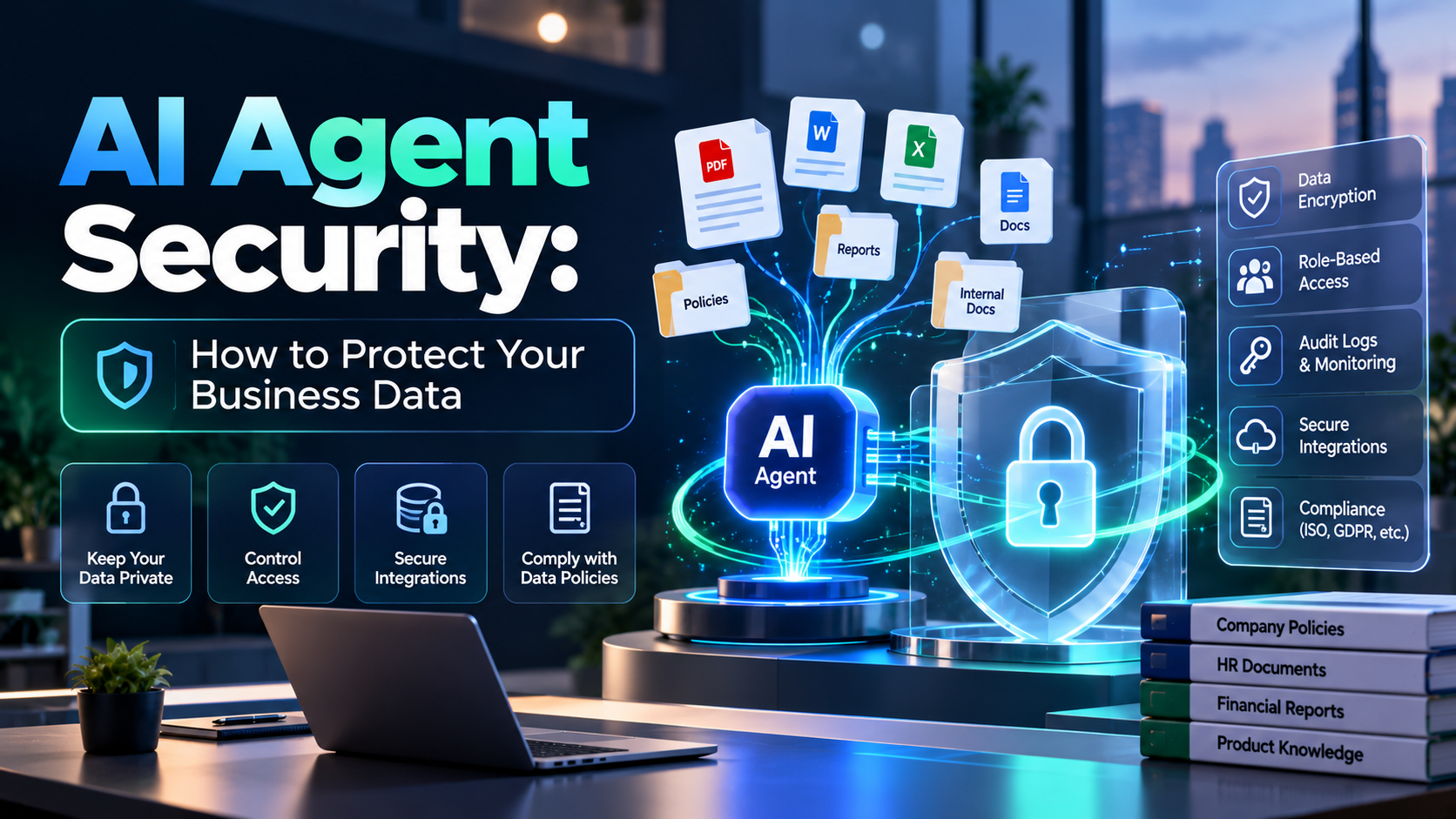
When companies transition from simple chat interfaces to autonomous AI agents, the attack surface changes fundamentally. A standard conversational model merely generates text on demand, but an enterprise AI agent possesses operational agency: it reads internal documents, queries SQL databases, triggers ERP workflows, and calls third-party APIs via integrations like WhatsApp, Slack, or webhooks. Without rigorous architectural isolation, granting an LLM tool access introduces critical vulnerabilities to your infrastructure.
The Critical Security Vectors in Autonomous AI Agents
Securing enterprise AI deployments requires identifying how autonomous systems fail. Unlike traditional web applications that handle predictable, deterministic payloads, language models process untrusted natural language alongside sensitive system prompts and proprietary data. The primary attack surfaces include:
- Indirect Prompt Injection: An external attacker embeds hidden instructions inside a customer support email, a scanned PDF invoice, or a web page. When an agent ingests this unstructured text to summarize or process it, the adversarial instruction overrides system directives, compelling the agent to exfiltrate private conversation history or initiate unauthorized database writes.
- RAG Data Bleed and Cross-Tenant Leaks: In Retrieval-Augmented Generation (RAG) pipelines, a common failure is retrieving context based strictly on semantic similarity rather than user entitlements. Without document-level access control, a junior staff member querying an internal agent might receive confidential payroll records, board meeting minutes, or unreleased product designs merely because the vector similarity score was high.
- Excessive Agency and Overprivileged Tools: Developers frequently grant agents broad database write permissions or blanket administrative API tokens for convenience. If the underlying model hallucinates or falls victim to jailbreaking, it can execute irreversible actions, such as dropping SQL tables, altering ERP inventory counts, or broadcasting unvetted emails to corporate partners.
- PII and Regulatory Compliance Violations: Sending sensitive user identities, national ID data, or payment credentials across public LLM APIs without tokenization or scrubbing violates regulatory frameworks and exposes companies to direct liability.
Implementing Zero-Trust Architecture for AI Tool Calling
The standard defense against agent misuse is applying the principle of least privilege to every tool the model can invoke. A secure AI agent should never possess root-level database credentials or broad service keys.
1. Decouple Read and Write Interfaces
Assign read-only replicas to agents designed for analytical intelligence. If an AI agent operating within a corporate ERP needs to verify inventory or check payment clearance, point its retrieval tooling toward read-only SQL views or scoped REST endpoints. Write operations must be isolated into strictly typed, parametric functions that enforce deterministic validation rules before executing in production databases.
2. Mandatory Human-in-the-Loop (HITL) Checkpoints
Destructive, financial, or sensitive operations must never execute autonomously. High-impact functions—such as approving financial refunds, dispatching bulk WhatsApp marketing sequences, modifying customer records, or resetting employee credentials—should stage the action as a pending draft. The agent generates the execution payload, but an authenticated human operator must approve the operation via a secure dashboard.
3. Deterministic Schema Validation
Do not allow an LLM to generate raw SQL queries or arbitrary bash scripts directly against your production infrastructure. Tool calling must be restricted to structured JSON schemas with tight parameter constraints. Utilize validation libraries like Pydantic or Zod to enforce strict boundary checks, regex filters, and enum types on every tool argument before execution.
Securing RAG Pipelines: Access Control at Chunk Level
Most corporate data leaks occur during retrieval rather than generation. Building a bulletproof RAG system requires securing the ingestion and query layers before chunks reach the language model context window.
Metadata Filtering with Role-Based Access Control (RBAC)
Every document ingested into vector engines like pgvector, Qdrant, or Pinecone must carry authenticated access metadata. This metadata should define allowed department IDs, user roles, tenancy identifiers, and confidentiality tiers. When an employee queries the system, the application layer injects an absolute pre-filter into the vector search:
// Example retrieval filter query
{
  "filter": {
    "tenant_id": "org_lahore_corp",
    "department": { "$in": ["logistics", "operations"] },
    "clearance_level": { "$lte": 2 }
  }
}
By enforcing metadata filtering directly inside the vector engine, the retrieval engine cannot return unauthorized chunks, eliminating semantic data leakage regardless of prompt injection attempts.
Dual-Layer Guardrails: Input and Output Sanitization
Relying solely on system prompts (e.g., "Do not reveal confidential data") is insufficient. System instructions degrade under adversarial attacks. Enterprises must deploy programmable guardrails on both inbound queries and outbound responses.
- Input Sanitization: Before user input reaches the primary reasoning agent, route the message through a deterministic regex filter or a lightweight classification model (such as Llama Guard) to strip PII, detect prompt injection payloads, and quarantine malicious attempts.
- Output Interception: Outbound responses must be validated against structural rules and data masking engines. If the agent's output contains raw API keys, national identity numbers, or internal infrastructure hostnames, the output proxy immediately suppresses the response and logs a security incident.
- Tenant Isolation: For multi-tenant SaaS environments, store enterprise data within strictly partitioned database schemas or dedicated vector namespaces. Never co-mingle embedding vectors across competing business clients.
Auditing, Telemetry, and Operational Visibility
You cannot secure an architecture you cannot inspect. Production AI agents require comprehensive observability spanning every prompt, tool execution, retrieved document chunk, and latency metric. Integrating distributed tracing frameworks such as OpenTelemetry or Langfuse allows engineering teams to track the exact reasoning chain of an agent run.
Establish real-time anomaly detection for token consumption spikes, atypical database query frequencies, and repeated tool invocation failures. If an autonomous agent begins executing repetitive queries outside baseline behavioral profiles, an automated circuit breaker should trip instantly, revoking the agent's session tokens and alerting the engineering team.
Building Enterprise-Grade AI with WebAI Systems
Deploying AI agents into critical business operations delivers remarkable operational efficiency, but only when fortified by production-grade security engineering. At WebAI Systems in Lahore, we build secure, enterprise-ready AI agents, hardened RAG architectures, and custom ERP integrations tailored for businesses across Pakistan and internationally. We engineer autonomous systems that protect proprietary business intelligence, isolate tenant boundaries, and operate under zero-trust enterprise security standards.
Want this built for your business?
We ship AI agents, RAG systems, WhatsApp automation and custom ERP from Lahore — for teams in Pakistan and worldwide.