
Blog · AI
WhatsApp RAG Chatbot For Clinics In Pakistan
*SEO brief (template)* Topic: WhatsApp RAG chatbot for clinics in Pakistan Primary keyword: WhatsApp RAG chatbot for clinics in Pakistan Intent: informational / commercial…
# WhatsApp RAG Chatbot for Clinics in Pakistan: A Practical Guide to AI-Powered Patient Communication
**Primary keyword:** WhatsApp RAG chatbot for clinics in Pakistan
**Search intent:** Informational / Commercial research
**Target audience:** Clinic owners, hospital administrators, healthcare businesses in Pakistan, and overseas healthcare entrepreneurs
**Brand:** WebAI Systems
## Introduction
For many clinics in Pakistan, WhatsApp has become an important channel for communicating with patients. People use it to ask about consultation fees, doctors' availability, clinic timings, appointment bookings, available services, and directions.
However, managing these conversations manually can become difficult as a clinic grows. Receptionists may spend hours answering repetitive questions, patients may have to wait for basic information, and appointment requests can get lost among unrelated messages.
A **WhatsApp RAG chatbot for clinics in Pakistan** can help address these operational challenges by combining WhatsApp automation with a knowledge-based AI assistant.
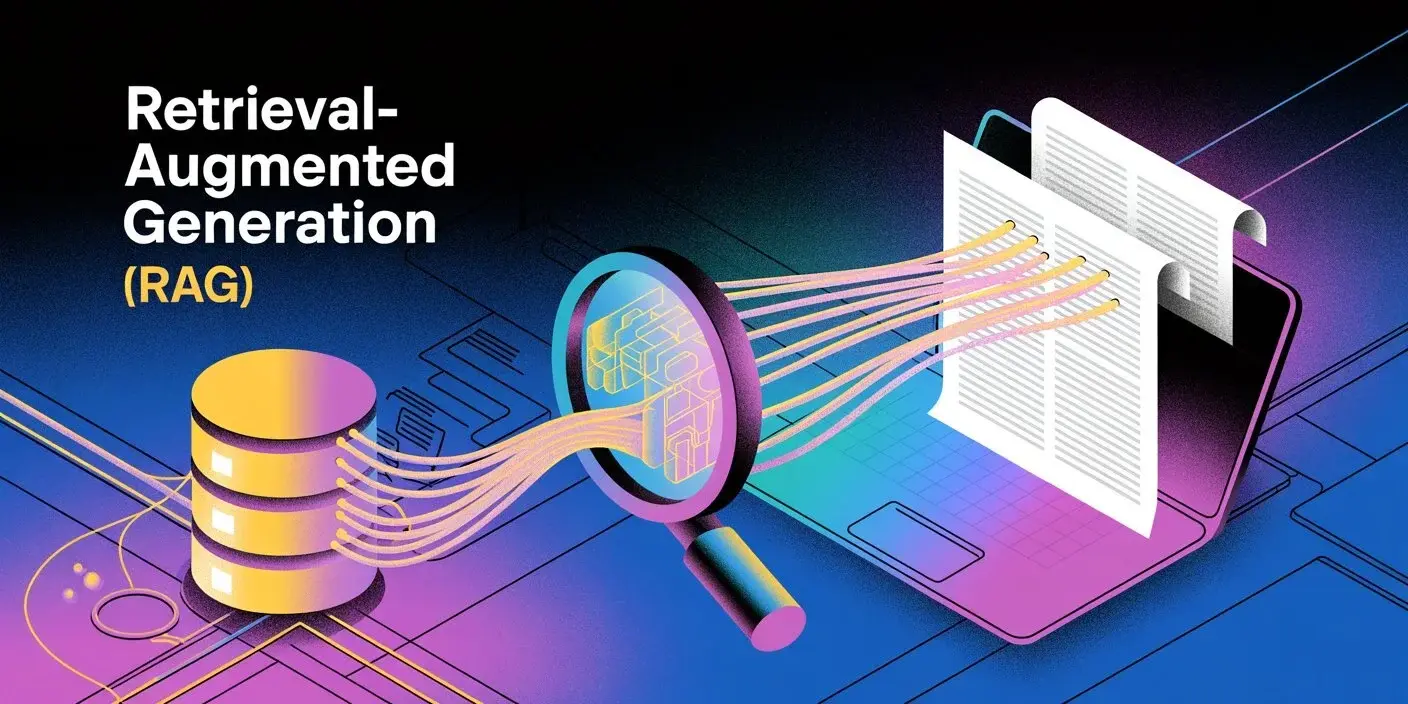
Instead of relying entirely on predefined replies, a Retrieval-Augmented Generation (RAG) chatbot can retrieve relevant information from a clinic's approved knowledge base and use that information to generate contextual responses.
For clinics exploring AI automation, the objective should be straightforward: provide accurate answers to routine questions, reduce repetitive administrative work, and make it easier for patients to reach the right person.
At WebAI Systems, we approach this through a combination of RAG architecture, WhatsApp Business integration, n8n workflows, and ERP or clinic-management system integration where required.
This guide explains how the technology works, where it can help, what implementation involves, and which factors clinic owners should evaluate before investing.
## 1. The Problem: Why Clinics Need Better WhatsApp Automation
A busy clinic receives different types of messages throughout the day. Some require a doctor's attention, while others can be answered using information the clinic has already published or approved.
Common patient inquiries include:
* What are your clinic timings?
* Which doctors are available today?
* What is the consultation fee?
* How can I book an appointment?
* Where is the clinic located?
* What services or diagnostic facilities do you offer?
* How can I reschedule an appointment?
When staff members answer these questions individually, the clinic spends valuable time handling repetitive communication.
### Common operational challenges
**Repetitive inquiries:** Receptionists repeatedly provide the same information about timings, fees, locations, and services.
**Delayed responses:** Messages received outside working hours may remain unanswered until the next working day.
**Missed appointment requests:** Without a structured process, appointment requests can be overlooked or require several manual follow-ups.
**Inconsistent information:** Different staff members may provide outdated or conflicting information about services, schedules, or policies.
**Limited visibility:** Clinic management may find it difficult to understand inquiry volumes, common patient questions, and response performance.
These challenges do not necessarily mean a clinic needs a complex AI system. Sometimes, a simple FAQ chatbot or structured WhatsApp workflow is sufficient.
The important question is whether the clinic's information is too varied, frequently updated, or context-dependent for predefined replies alone.
That is where a RAG-based approach can become useful.
## 2. What Is a WhatsApp RAG Chatbot?
RAG stands for Retrieval-Augmented Generation. It is an AI architecture that combines information retrieval with a language model.
Rather than asking an AI model to answer every question from its general training, a RAG system first retrieves relevant information from a designated knowledge source. The model then uses that retrieved information to formulate an answer.
For a clinic, the knowledge base might contain:
* Approved clinic FAQs
* Doctor profiles and specialties
* Consultation fees and service descriptions
* Clinic timings and branch locations
* Appointment policies
* Preparation instructions approved by clinical staff
* Administrative procedures and patient guidance
When a patient sends a WhatsApp message, the chatbot identifies the question, retrieves relevant information, and generates a response based on the available material.
For example, a patient might ask:
"Is Dr. Ahmed available on Saturday, and what is the consultation fee?"
The system can retrieve the relevant doctor's schedule and fee information, then respond with the available details.
However, if the schedule is stored in a live clinic-management system, the chatbot should check that system rather than rely on a static document that could be outdated.
This distinction is essential: **RAG retrieves knowledge; it does not automatically guarantee that the information is correct or current.**
## 3. How Does a WhatsApp RAG Chatbot Work?
A typical implementation combines several components, each responsible for a different part of the process.
### Step 1: Patient sends a WhatsApp message
The patient contacts the clinic through its WhatsApp Business number.
For example:
"Please tell me the timings for your dermatology department."
### Step 2: WhatsApp receives the message
A WhatsApp Business Platform integration receives the incoming message and passes it to the automation backend.
An integration provider or API service may be used depending on the clinic's requirements and deployment approach.
### Step 3: n8n processes the request
n8n can coordinate the workflow, including message processing, routing, API requests, appointment-related actions, and escalation to clinic staff.
It acts as the automation layer rather than the knowledge base itself.
### Step 4: The RAG system retrieves relevant information
The patient's question is converted into a retrieval query. The system searches the clinic's approved knowledge base for relevant information.
Depending on the architecture, this may involve document chunking, embeddings, vector search, metadata filtering, or a combination of retrieval techniques.
### Step 5: The AI generates a response
The language model receives the patient's question and the retrieved context.
It generates a response using the available information, subject to the system's instructions and safeguards.
If the answer cannot be supported by the retrieved information, the chatbot should acknowledge the limitation and direct the patient to clinic staff.
### Step 6: The response is delivered through WhatsApp
The generated answer is returned to the patient through the WhatsApp integration.
For actions such as booking an appointment, the workflow can request additional details and interact with the clinic's scheduling system.
### Step 7: Staff handle cases requiring human attention
Questions involving clinical judgment, uncertain information, complaints, urgent symptoms, or exceptions can be routed to an authorized staff member.
The goal is not to remove people from patient communication. It is to let automation handle appropriate routine tasks while preserving human oversight.
## 4. Benefits of a WhatsApp RAG Chatbot for Clinics in Pakistan
The benefits depend on the clinic's workflow, the quality of its information, and how the system is implemented.
### 24/7 responses to routine questions
A properly deployed chatbot can respond to supported administrative inquiries outside normal clinic hours.
This does not mean a doctor or receptionist is available around the clock. It means patients can access approved information without waiting for a staff member to become available.
### Reduced repetitive workload
Receptionists can spend less time answering routine questions and more time managing appointments, coordinating patients, and handling exceptions.
The actual time saved should be measured after deployment rather than assumed in advance.
### More consistent communication
A centralized knowledge base helps ensure that patients receive consistent information about clinic policies, timings, services, and locations.
When information changes, administrators can update the source rather than manually changing numerous individual replies.
### Appointment booking and reminders
When connected to a suitable scheduling system, the chatbot can help patients request, confirm, reschedule, or cancel appointments.
Automated reminders may also be possible, subject to patient consent, system capabilities, and applicable messaging rules.
The workflow must check real appointment availability before confirming a booking.
### Support for Urdu and English
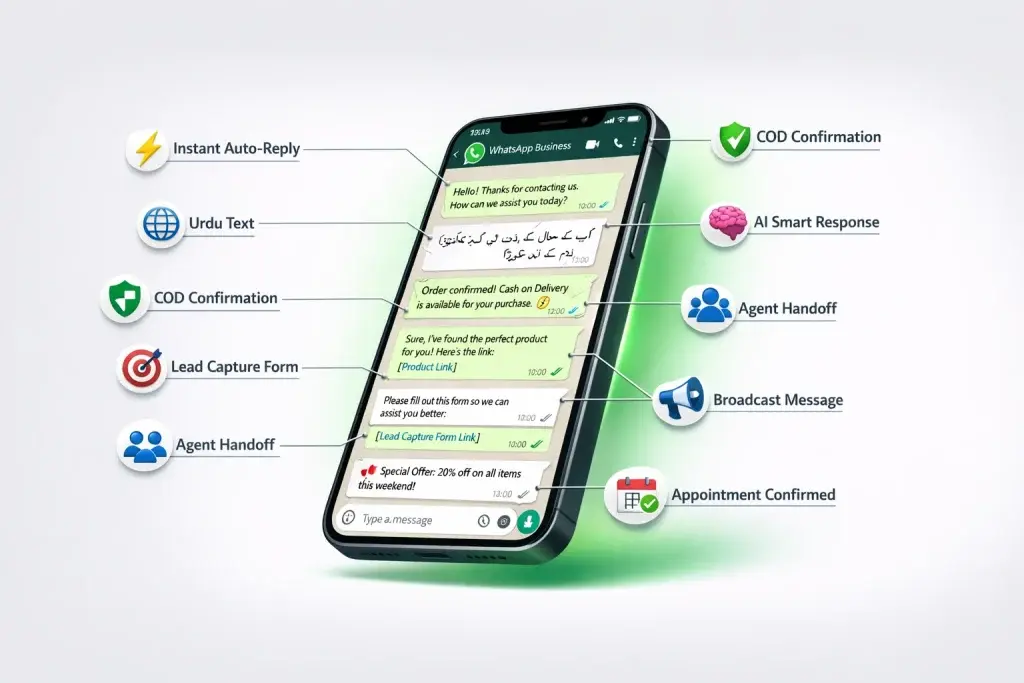
A multilingual chatbot can be configured to handle English and Urdu conversations, with support for other languages where required.
For Pakistani clinics, this can make communication more accessible to patients who are more comfortable writing in Urdu.
Language support should be tested using real-world phrasing, Roman Urdu, spelling variations, and local terminology. A model's ability to generate Urdu does not automatically guarantee accurate medical communication.
### Integration with clinic operations
A chatbot can connect with existing business systems to reduce manual data entry and keep administrative workflows coordinated.
For example, an appointment request received through WhatsApp could be processed by an automation workflow and recorded in the clinic's scheduling or ERP system.
This is particularly useful for clinics operating multiple branches or managing high volumes of patient inquiries.
## 5. Practical Use Cases for Pakistani Clinics
Not every clinic needs the same chatbot. The implementation should reflect the clinic's services, inquiry volume, and administrative processes.
### Use case 1: Clinic information assistant
The chatbot answers questions about:
* Opening and closing hours
* Branch addresses and directions
* Available specialties
* Doctor profiles
* Consultation fees
* Contact information
This is often a practical starting point because the information can be maintained in an approved knowledge base.
### Use case 2: Appointment booking assistant
The chatbot collects the information required to request an appointment, such as the preferred doctor, date, and available time.
It then checks the scheduling system and follows the clinic's booking rules.
A reliable implementation should distinguish between an appointment request and a confirmed appointment.
### Use case 3: Appointment reminders
The system can send reminders before scheduled appointments and provide options to confirm or request a change.
Message timing, consent, WhatsApp messaging rules, and the clinic's cancellation policy must be considered.
### Use case 4: Branch and department routing
For clinics with multiple branches or specialties, the chatbot can identify the patient's preferred location or department and provide the appropriate information.
If the request requires staff assistance, it can route the conversation to the relevant team.
### Use case 5: Administrative patient support
The chatbot can explain approved administrative procedures, such as how to obtain a copy of a report, what documents to bring, or how to contact the relevant department.
Access to private records must be protected through appropriate identity verification and authorization.
### Use case 6: Internal staff knowledge assistant
A separate internal chatbot can help authorized employees find operational information, such as standard operating procedures, staff guidelines, and administrative policies.
This should be separated from the patient-facing chatbot so that internal information is not accidentally disclosed to patients.
## 6. What a Clinic RAG Chatbot Should Not Do
Healthcare automation requires stricter boundaries than a typical customer-support chatbot.
A clinic chatbot should not independently diagnose a patient, prescribe medication, recommend treatment changes, or interpret complex symptoms as a substitute for a qualified healthcare professional.
For example, if a patient asks:
"I have chest pain and difficulty breathing. Which medicine should I take?"
The chatbot should not generate a routine medical recommendation from a knowledge-base document. It should follow a clinically reviewed escalation protocol and direct the patient to appropriate emergency assistance.
Other safeguards should include:
**No unsupported answers:** If relevant information is unavailable, the chatbot should say so rather than inventing a response.
**No fabricated availability:** Appointment slots must be checked against the live scheduling system.
**No unauthorized disclosure:** Patient-specific information should only be provided after appropriate verification and access checks.
**No uncontrolled knowledge sources:** The system should retrieve information from approved sources, not arbitrary internet content.
**Human escalation:** Patients must have a clear way to reach clinic staff when the chatbot cannot help.
A RAG architecture can reduce some types of unsupported answers, but it cannot eliminate hallucinations, retrieval errors, or misunderstandings. Testing and operational safeguards remain necessary.
## 7. How to Implement a WhatsApp RAG Chatbot for a Clinic
A successful implementation begins with the clinic's actual workflow, not with selecting an AI model.
### Phase 1: Requirements and workflow analysis
Identify the questions patients ask most frequently and determine which tasks should be automated.
Document the existing appointment process, staff responsibilities, escalation requirements, and systems already in use.
### Phase 2: Knowledge-base preparation
Collect and organize approved clinic information.
Remove outdated documents, resolve conflicting details, and assign responsibility for maintaining the information.
For RAG, document quality is critical. Poor or inconsistent source material leads to poor retrieval and unreliable answers.
### Phase 3: WhatsApp integration
Configure the WhatsApp messaging channel and connect it to the backend workflow.
The choice of integration should account for official platform requirements, message templates where applicable, account setup, operational reliability, and ongoing costs.
### Phase 4: RAG architecture
Build the retrieval pipeline, select an appropriate embedding model and vector database if required, and configure the language model.
The system should retrieve relevant content, respect access restrictions, and respond appropriately when evidence is insufficient.
### Phase 5: n8n workflow automation
Create workflows for incoming messages, knowledge retrieval, appointment requests, notifications, staff handoff, and error handling.
n8n can coordinate these processes, while application code and external services handle the responsibilities that require them.
### Phase 6: ERP or clinic-management integration
Where appropriate, connect the chatbot with the clinic's existing systems.
Possible integrations include:
* Appointment scheduling
* Doctor and branch directories
* Patient registration
* Billing or payment workflows
* Administrative reporting
Integrations should use authenticated APIs and enforce permissions. A chatbot should not receive unrestricted access to the clinic database.
### Phase 7: Testing and controlled launch
Test the chatbot against realistic questions, including ambiguous requests, incorrect spelling, Roman Urdu, outdated information, and questions outside its scope.
Measure answer accuracy, successful retrieval, appointment workflow completion, escalation performance, and response latency.
Launch with a limited set of use cases, review real-world performance, and expand only after the workflow is reliable.
## 8. Costs: What Determines the Price of a WhatsApp RAG Chatbot?
There is no single reliable price for every clinic. The cost depends on the scope of the implementation and the services used.
Providing a fixed price without understanding the clinic's requirements would be misleading.
### Main cost factors
| Component | What affects the cost |
| ------------------ | -------------------------------------------------------------------- |
| WhatsApp messaging | Message categories, destination market, volume, and provider charges |
| AI model | Model selection, input/output tokens, and usage volume |
| RAG infrastructure | Hosting, embeddings, vector database, and document volume |
| Automation | Number and complexity of n8n workflows |
| System integration | Existing APIs, ERP, scheduling, and database architecture |
| Security | Access controls, audit logging, and data-protection measures |
| Maintenance | Monitoring, knowledge updates, troubleshooting, and support |
WhatsApp Business Platform charges depend on factors such as the recipient's market and message category. Meta publishes its current pricing through its official pricing page. Some service and utility messages have different charging conditions, so clinics should verify the applicable rates before estimating their monthly budget.
Official pricing reference: https://whatsappbusiness.com/products/platform-pricing/
A practical cost assessment should separate:
1. **Initial development:** Requirements, chatbot development, integration, and testing.
2. **Recurring infrastructure:** Hosting, AI usage, databases, and monitoring.
3. **Messaging costs:** WhatsApp platform or provider charges.
4. **Ongoing support:** Maintenance, updates, and operational assistance.
Clinics should also ask whether the proposed solution has usage limits, what happens when a workflow fails, and who is responsible for updating the knowledge base.
The most useful comparison is the total cost of operating the system against measurable operational improvements, not simply the cost of the AI model.
## 9. Patient Privacy, Security, and Regulatory Considerations in Pakistan
Patient information requires careful handling. A clinic should evaluate privacy and security before connecting its WhatsApp conversations to an AI system.
The Punjab government's published healthcare-provider obligations include protecting patient records and confidentiality, with disclosure limited to circumstances permitted by law or in the patient's healthcare interests.
Reference: https://dghs.punjab.gov.pk/health_care_provider
The precise legal requirements for a particular clinic depend on its location, services, applicable healthcare rules, and the systems it uses. Requirements should be reviewed with qualified legal or compliance professionals before deployment.
### Recommended security measures
**Data minimization:** Collect only the information necessary for the specific task.
**Access control:** Restrict patient records and administrative functions to authorized users.
**Secure transmission and storage:** Use appropriate encryption and secure credentials throughout the system.
**Retention policies:** Define how long messages, logs, and patient information are retained.
**Auditability:** Record relevant system actions without unnecessarily duplicating sensitive patient data.
**Vendor assessment:** Review how WhatsApp providers, AI services, hosting providers, and other vendors process and retain information.
**Patient transparency:** Explain when patients are interacting with an automated assistant and how their information is handled.
**Clinical oversight:** Have qualified personnel review any health-related content that the chatbot is permitted to communicate.
Clinics should also assess whether sending patient information to third-party AI services is appropriate under their applicable legal, contractual, and privacy obligations.
Do not assume that using WhatsApp, a cloud provider, or an AI API automatically makes a healthcare workflow compliant.
Before publication and deployment, verify the current status of applicable Pakistani data-protection legislation, provincial healthcare requirements, and relevant platform policies. Regulatory requirements can change, and a technical implementation alone does not establish compliance.
## 10. Why Choose WebAI Systems for Clinic Automation?
WebAI Systems focuses on building practical AI and automation solutions around real business processes.
For clinics, that means designing a solution around the information patients need, the tasks staff perform, and the systems the organization already uses.
Our approach can combine the following capabilities.
### RAG and knowledge-based AI
We can build a retrieval-based assistant that uses a clinic's approved documents and information sources to answer routine questions.
Explore our [RAG solutions](/rag).
### WhatsApp AI business automation
We can connect WhatsApp conversations with automated workflows for patient inquiries, appointment requests, notifications, and staff handoffs.
Learn more about [WhatsApp AI business automation](/services/whatsapp-ai-business-automation).
### n8n workflow automation
We use workflow automation to coordinate messaging, API integrations, notifications, and business processes.
Explore our [automation services](/automation).
### ERP and clinic-system integration
Where suitable APIs and permissions are available, we can connect the chatbot with existing business systems to reduce manual work and improve operational consistency.
The integration scope depends on the clinic's software, data model, security requirements, and workflow.
### A practical implementation strategy
We recommend starting with a clearly defined use case rather than attempting to automate every patient interaction at once.
For many clinics, a sensible first phase is to automate routine administrative FAQs, establish human handoff, and measure performance before introducing appointment management or deeper system integrations.
The architecture should be designed around the clinic's needs, not around a predetermined technology stack.
## 11. Is a WhatsApp RAG Chatbot Right for Your Clinic?
A RAG chatbot may be worth evaluating if your clinic:
* Receives a high volume of repetitive WhatsApp inquiries.
* Maintains substantial information about doctors, services, and branches.
* Needs to provide routine information outside business hours.
* Wants to connect patient communication with appointment workflows.
* Has staff available to maintain the knowledge base and manage escalations.
* Can establish appropriate privacy, security, and clinical oversight.
A simpler FAQ bot may be sufficient if your information is limited and rarely changes.
Likewise, a RAG chatbot alone will not solve problems caused by poor scheduling processes, outdated clinic records, or unclear staff responsibilities.
The best starting point is to identify one measurable operational problem and determine whether AI retrieval and automation can address it reliably.
## 12. Next Steps: Discuss Your Clinic's Requirements with WebAI Systems
If you are planning to introduce a WhatsApp RAG chatbot for your clinic in Pakistan, begin by documenting your most common patient inquiries and the systems your staff currently use.
Consider these questions:
* How many WhatsApp inquiries does your clinic receive daily?
* Which questions consume the most staff time?
* Do you need appointment booking, or only automated information?
* Is your doctor and appointment information available through an API?
* Does your clinic operate one branch or multiple locations?
* What privacy, security, and human-review requirements apply?
These answers will help determine the right architecture, implementation scope, and operating budget.
WebAI Systems can help assess the requirements and design a solution combining RAG, WhatsApp automation, n8n, and ERP integration where appropriate.
**Want to explore a WhatsApp AI assistant for your clinic?**
[Contact WebAI Systems](/contact) to discuss your workflows, integration requirements, and implementation options.
---
## Frequently Asked Questions
### What is a WhatsApp RAG chatbot for clinics in Pakistan?
It is a WhatsApp-connected AI assistant that retrieves information from a clinic's approved knowledge base and uses it to answer patient inquiries. It can also connect to scheduling or business systems when suitable integrations are available.
### Can a WhatsApp RAG chatbot book appointments?
Yes, if it is integrated with a scheduling system that supports the required operations. The chatbot should verify availability and confirm the appointment only after the booking has been successfully recorded.
### Can the chatbot answer patients in Urdu?
It can be configured for Urdu and English, including selected Roman Urdu patterns. Accuracy should be evaluated using realistic patient messages and clinic-specific terminology.
### Does a RAG chatbot provide medical diagnoses?
A general clinic-support chatbot should not independently diagnose patients or prescribe treatment. Clinical questions should follow a professionally reviewed process for safe responses and escalation.
### How much does a WhatsApp RAG chatbot cost in Pakistan?
The cost depends on development scope, messaging charges, AI usage, hosting, integrations, and maintenance. A reliable estimate requires an assessment of the clinic's workflows and expected usage.
### Can it integrate with an existing ERP or clinic-management system?
Potentially, yes. Integration depends on the system's available APIs, data structure, authentication, and permissions. The chatbot should only access the information and functions required for its approved tasks.
### Is a WhatsApp AI chatbot secure for patient information?
Security depends on the complete implementation, including data handling, access controls, vendors, storage, retention, and operational policies. Clinics should complete a privacy and security assessment before processing patient information.
### Does a clinic need RAG, or is a normal chatbot enough?
A predefined FAQ bot may be sufficient for a small set of fixed questions. RAG becomes more useful when answers depend on a larger collection of documents or information that needs to be retrieved contextually.
## Final Thoughts
A WhatsApp RAG chatbot can help clinics improve routine patient communication, reduce repetitive administrative work, and connect messaging with existing operational systems.
But the value does not come from adding AI to WhatsApp alone. It comes from accurate information, reliable workflows, appropriate integrations, clear clinical boundaries, and responsible handling of patient data.
For clinics in Pakistan, the practical approach is to start with a focused use case, validate its performance, and expand based on measurable results.
WebAI Systems helps businesses explore this approach through RAG development, WhatsApp AI automation, n8n workflows, and ERP integrations.
Explore [RAG solutions](/rag), [automation services](/automation), or [WhatsApp AI business automation](/services/whatsapp-ai-business-automation) to learn more.
Want this built for your business?
We ship AI agents, RAG systems, WhatsApp automation and custom ERP from Lahore — for teams in Pakistan and worldwide.