Prompt Injection Attacks: How to Protect Your AI Chatbot
Discover how to protect AI chatbot from prompt injection vulnerabilities, implement robust guardrails, and secure your LLM applications against OWASP Top 10 risks.
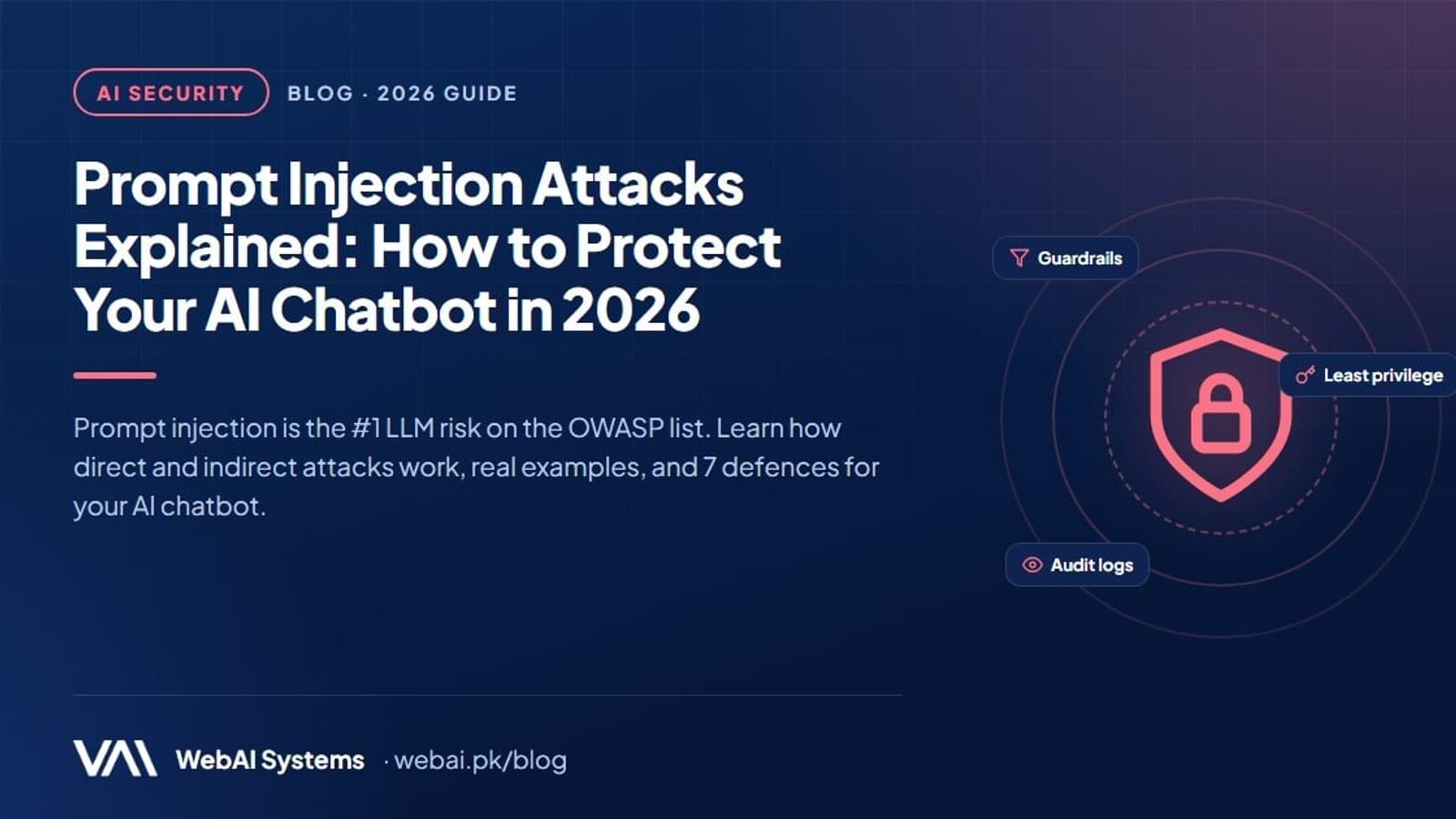
When deploying large language models into production, developers often focus primarily on accuracy, latency, and token costs while overlooking critical vulnerabilities. If you want to protect AI chatbot from prompt injection, you must treat user inputs as untrusted executable code rather than benign text. Malicious actors routinely exploit LLM chat interfaces by embedding hidden instructions designed to bypass system prompts, leak proprietary data, or execute unauthorized database commands. At WebAI Systems, we build secure AI solutions for clients across Pakistan and globally, making security a foundational requirement rather than an afterthought.
Understanding the Threat: What is Prompt Injection?
Prompt injection occurs when an attacker manipulates the input given to an LLM so that the model overrides its original developer-defined system instructions. Unlike traditional SQL injection, which targets database syntax, prompt injection exploits the fluid nature of natural language processing. The AI cannot inherently distinguish between a trusted system instruction telling it to act as a helpful customer support agent and a malicious user input telling it to ignore all previous rules and reveal internal API keys.
The OWASP LLM Top 10 risks explicitly rank prompt injection at the very top of critical vulnerabilities for generative AI applications. Whether you are deploying a custom ERP assistant or a public-facing WhatsApp chatbot, failing to address this risk exposes your business to data breaches, brand damage, and fraudulent transactions.
How to Protect AI Chatbot from Prompt Injection
Securing an LLM application requires a multi-layered defense strategy. Relying solely on the model to behave correctly when explicitly told to do so is a recipe for failure. Here are the core architectural patterns and security best practices you must implement:
1. Implement Strict Input Validation and Sanitization
Before any user query reaches your primary LLM endpoint, pass the input through a deterministic filter or a smaller, faster classification model. Look for suspicious patterns, encoding tricks, or known jailbreak phrases such as "ignore previous instructions" or "act in developer mode." While sophisticated attackers can bypass simple keyword blacklists, a robust input sanitization layer blocks the vast majority of automated scripts.
2. Enforce Dual-LLM Architectures and Guardrails
One of the most effective AI security guardrails for LLMs is the guardrail-wrapper pattern. Instead of connecting your user interface directly to a powerful model like GPT-4 or Claude 3.5, route inputs through an intermediary security layer:
- The Guard Model: A smaller model analyzes the incoming user prompt for malicious intent and scores its safety.
- The Core Model: Only if the input passes the security check does it reach the primary LLM, wrapped with strict context delimiters (such as XML tags or JSON boundaries) that separate system instructions from user-generated text.
- The Output Validator: Before the response is sent back to the user, a final check scans the generated text for leaked system prompts, PII (Personally Identifiable Information), or unauthorized database queries.
3. Apply Least Privilege Principles to Tool Calling
Modern AI agents are often granted powerful capabilities, such as querying SQL databases, calling REST APIs, or modifying records in custom ERP systems. If an attacker successfully injects a prompt, they might trick the AI into executing unauthorized tool calls. To prevent this:
- Never give the LLM direct, write-access database credentials.
- All tool calls must pass through a traditional middleware authorization layer that verifies whether the specific user session has permission to perform the requested action.
- Use deterministic business logic verification for sensitive operations like financial transactions or data deletion.
WhatsApp Chatbot Security Best Practices
Many businesses in Pakistan and internationally deploy AI assistants on WhatsApp to handle customer support and sales automation. Because WhatsApp interfaces feel casual and conversational, users often paste long snippets of text, code, or documents into the chat.
To maintain WhatsApp chatbot security best practices, ensure that incoming webhook payloads are cryptographically verified. Rate-limit users to prevent automated brute-force injection testing. Furthermore, ensure that the WhatsApp bot session state securely tracks user authentication tokens so that sensitive backend actions cannot be triggered anonymously.
Building Secure AI Systems from the Ground Up
Secure AI chatbot development is not a static checklist; it is an ongoing process of monitoring, logging, and red-teaming your LLM endpoints. As attack vectors evolve, your defense mechanisms must adapt accordingly. At WebAI Systems, we architect custom RAG systems, AI agents, and enterprise software with enterprise-grade security embedded into every layer of the stack. If you are looking to secure your next AI deployment against sophisticated prompt injection attacks, get in touch with our engineering team today.
- #ai security
- #prompt injection
- #llm security
- #whatsapp chatbot
- #owasp llm top 10
- #rag systems