RAG vs Fine-Tuning for Business Data
Compare RAG vs fine-tuning for your enterprise data. Learn costs, use cases, and implementation strategies for business AI systems.
When technical leaders and business founders decide to integrate internal company data into artificial intelligence models, they invariably hit a major architectural crossroads: RAG vs fine-tuning. Choosing the wrong approach leads to wasted budgets, hallucinated outputs, and outdated information. At WebAI Systems, we build custom AI agents and knowledge architectures for companies across Pakistan and internationally, and this is the single most common design debate we encounter.
Understanding RAG vs Fine-Tuning
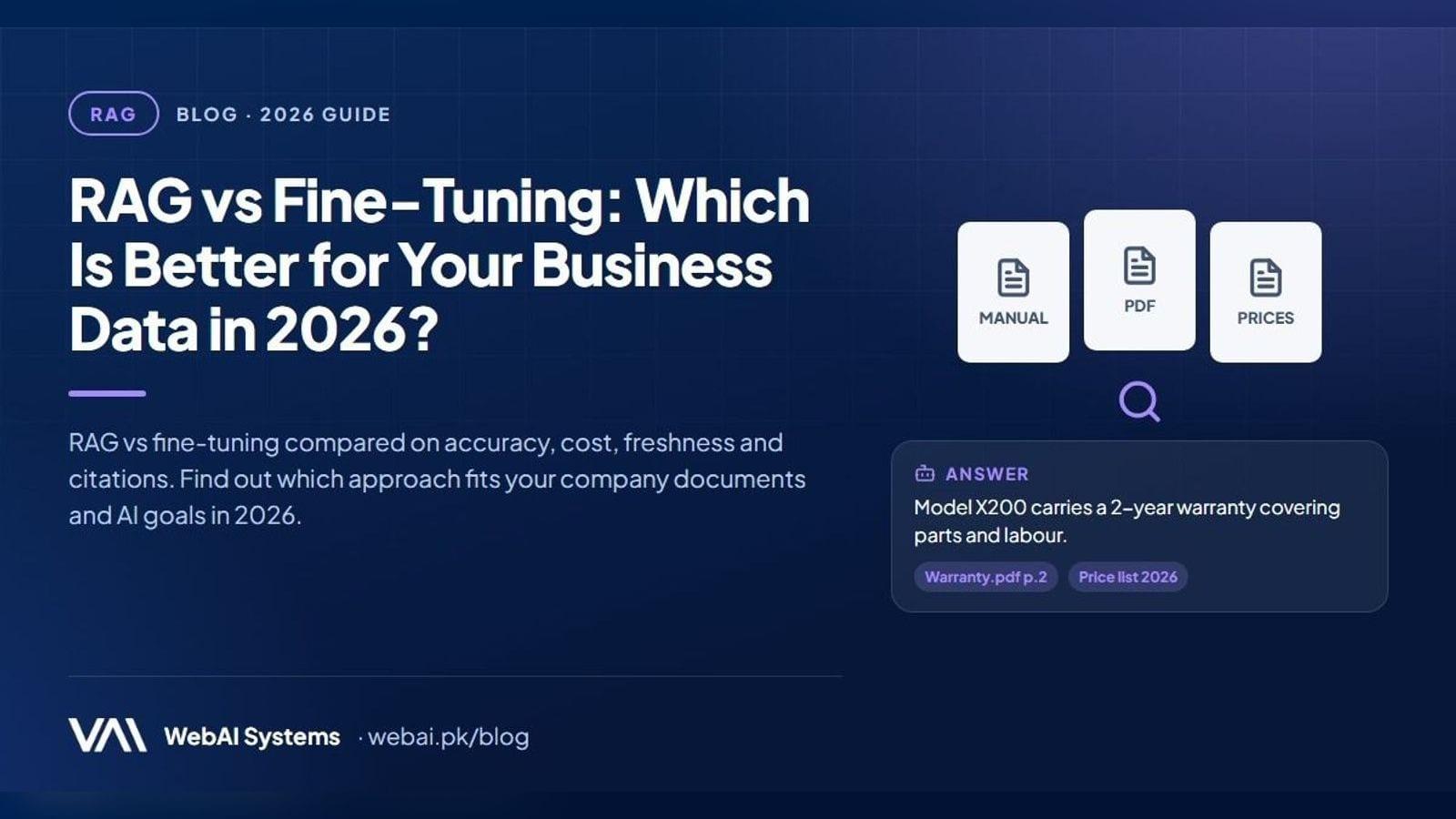
To make the right choice for your enterprise, you must first understand the fundamental mechanics of both methods. They serve entirely different purposes, though many beginners assume they are interchangeable. Retrieval-Augmented Generation connects an existing Large Language Model to an external database, document store, or custom ERP. When a user asks a question, the system searches your internal files, retrieves the exact paragraphs needed, and feeds them to the AI model as context to generate an accurate answer.
Fine-tuning, on the other hand, involves taking a base model and training it further on a curated dataset of input-output pairs. This alters the underlying neural network weights. Fine-tuning teaches the model a specific tone, style, or deep domain heuristic, but it is notoriously poor at memorizing rapidly changing factual data.
When to Use Retrieval-Augmented Generation
Retrieval-augmented generation shines when your business relies on factual accuracy, secure document search, and real-time updates. Consider these concrete scenarios:
- Your company policy documents, standard operating procedures, and product price lists change weekly.
- You need strict citation so users can verify where the AI retrieved an answer.
- You operate in legal, medical, or financial sectors where hallucinations are completely unacceptable.
Learning how to implement RAG for business effectively requires setting up a robust vector database, chunking your enterprise documents logically, and implementing hybrid search algorithms that combine semantic understanding with exact keyword matching.
When to Use Enterprise Model Fine-Tuning
Fine-tuning is rarely used for simple document Q&A today. Instead, AI model training for enterprise data is best reserved for specific behavioral modifications:
- Enforcing a strict brand voice, formatting style, or output structure (such as JSON generation for custom software).
- Teaching the model rare domain terminology, proprietary code syntax, or industry jargon that base models misunderstand.
- Automating classification tasks where the output taxonomy is fixed and unchanging.
Comparing Costs and Implementation Complexity
Budget is a primary constraint for most business owners. Evaluating custom RAG knowledge systems cost versus model training reveals a stark contrast in resource allocation.
Building a RAG pipeline is generally much faster and cheaper. You do not pay for expensive GPU cluster training hours. You pay for software development, embedding generation, vector storage, and API routing. Furthermore, updating your data is as simple as deleting an old PDF from your S3 bucket and uploading a new one.
Conversely, fine-tuning requires gathering thousands of pristine training examples, cleaning data, managing training hyperparameters, and hosting heavy custom weights. Every time your underlying business data changes, you must repeat the training process, leading to high recurring maintenance expenses.
The Hybrid Approach: The Best of Both Worlds
For most modern enterprises, the ideal solution is not an absolute binary choice. The most advanced systems use a hybrid architecture. You use fine-tuning to train a model to understand your specific workflow steps, follow strict system prompts, and format API calls cleanly. Then, you use a robust RAG layer to feed real-time customer history, product inventories, and internal wikis into that fine-tuned model at inference time.
If you are planning an internal automation project, building a customer support WhatsApp bot, or integrating AI into your enterprise software, evaluate your data volatility first. If your data changes daily, RAG is mandatory. If your workflow requires specialized behavioral patterns, fine-tuning provides the edge. Contact WebAI Systems today to discuss your architecture and build a secure, scalable AI solution tailored to your operational needs.
- #rag
- #fine-tuning
- #enterprise ai
- #artificial intelligence
- #custom software