
Blog · AI
AI Agents vs. AI Chatbots: Which Does Your Business Need?
Discover the critical differences between basic AI chatbots and autonomous AI agents. Learn which system your business needs to cut costs and automate workflows.
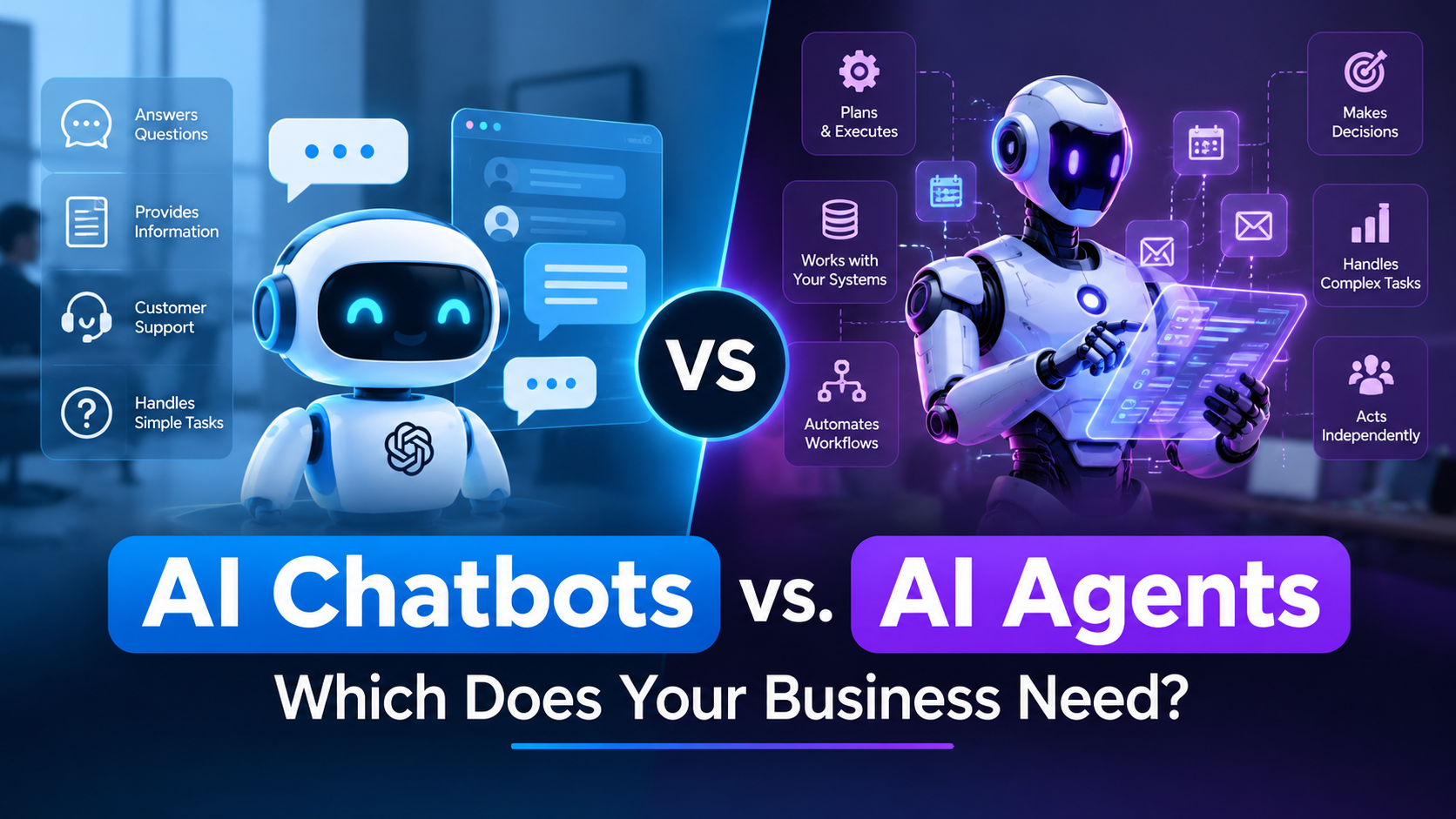
When business leaders in Lahore and across international markets approach WebAI Systems to upgrade their customer service and internal operations, they almost always ask for a chatbot. But when we dig deeper into what they actually want to achieve—such as updating inventory records, processing custom refunds, or executing multi-step enterprise workflows—a simple chatbot falls desperately short. The conversation quickly pivots from chatbots to autonomous AI agents.
Understanding the distinction between an AI chatbot and an AI agent is no longer just a technical nuance. It is a strategic imperative that determines whether your software investment drives real revenue or becomes just another expensive novelty. Let us break down what each system does, where they fail, and which one your business actually needs.
What Is a Traditional AI Chatbot?
A standard AI chatbot is fundamentally reactive. Powered by Large Language Models (LLMs) and fine-tuned prompt engineering, it excels at natural language processing, answering frequently asked questions, and retrieving static information. It waits for user input, processes the text, and outputs a response based on its training data or integrated knowledge base.
Consider a typical customer support scenario for an e-commerce brand based in Karachi. A customer types, "Where is my order?" A well-built chatbot queries your database, finds the tracking number via an API call, and replies, "Your order has shipped and will arrive tomorrow." This is a classic, highly effective use case for a chatbot.
However, chatbots hit a rigid wall the moment the task requires multi-step reasoning, conditional logic, or executing changes across disparate systems without human oversight. If the customer responds, "My address is wrong, please change it to DHA Phase 5 and expedite shipping," a standard chatbot will typically fail, break character, or default to saying, "Please contact a human agent."
What Is an Autonomous AI Agent?
An AI agent is an advanced system that goes far beyond conversational response generation. Built by teams at WebAI Systems using frameworks like LangChain or custom orchestration layers, an AI agent is designed for goal-driven execution. Instead of just talking about a problem, an AI agent takes autonomous actions to solve it.
An AI agent consists of four core components:
- The LLM Core: The reasoning engine that interprets the user's intent and plans the next steps.
- Planning and Memory: The ability to break a complex request into a sequence of sub-tasks, retaining context over long horizons.
- Tools and APIs: Direct access to execute external functions, such as writing to your custom ERP, modifying database rows, or sending WhatsApp notifications.
- Autonomy and Reflection: The capacity to evaluate whether a step succeeded, handle errors, and retry with a different approach if an API call fails.
Returning to our e-commerce example, an AI agent handles the address change effortlessly. It parses the request, checks your custom ERP to verify if the order has left the warehouse, calculates the fee for expedited shipping, updates the delivery address in the logistics database, sends a payment link via WhatsApp, and confirms the update to the customer—all in one fluid, autonomous loop.
Comparing Capabilities: Chatbot vs. Agent
To make the right investment for your tech stack, review how these two architectures compare across critical business dimensions:
- Workflow Complexity: Chatbots handle single-turn or simple conversational turns. Agents handle complex, multi-step workflows spanning hours or days.
- System Integration: Chatbots typically read data (Retrieval-Augmented Generation or simple lookups). Agents read and write data across your web apps, CRM, and databases.
- Error Handling: Chatbots give up when confused and route to humans. Agents troubleshoot, re-prompt themselves, or use alternative APIs to complete the objective.
- Cost and Complexity: Chatbots are faster and cheaper to deploy. AI agents require robust guardrails, rigorous testing, and sophisticated backend engineering.
Which One Does Your Business Actually Need?
Neither technology is universally superior; they serve completely different tiers of operational challenge. Here is how to decide what your organization requires.
When You Only Need an AI Chatbot
Build or deploy a chatbot if your primary bottleneck is information retrieval and basic deflection of repetitive inquiries. Ideal use cases include:
- An internal HR knowledge base where employees query company policies, leave rules, and benefits.
- A customer-facing FAQ bot on your website that guides users to existing help articles.
- Basic lead qualification on WhatsApp, where the bot simply collects a name, phone number, and industry before routing the lead to a human sales rep.
If your team spends hours answering the exact same questions via email or chat, a RAG-powered chatbot built by WebAI Systems will instantly save you dozens of hours every week.
When You Need an AI Agent
Invest in custom AI agents if your operations involve fragmented software, manual data entry, and multi-step processes that require human coordination. Ideal use cases include:
- Automated Order Fulfillment: Processing unstructured purchase orders received via email or WhatsApp, validating inventory in your ERP, and generating invoices without human touch.
- Dynamic Customer Support & Operations: Processing refunds, canceling subscriptions, rescheduling appointments, and updating CRM records automatically based on chat interactions.
- Autonomous Data Scraping and Research: Agents that continuously monitor competitor pricing, analyze market trends, and draft internal reports ready for executive review.
Building the Right Solution with WebAI Systems
Many businesses make the mistake of over-engineering with expensive agentic workflows when a simple retrieval chatbot would suffice—or conversely, they try to scale a basic chatbot into complex operations, resulting in frustrated users and broken workflows.
At WebAI Systems, we design custom software solutions tailored to the exact maturity and goals of your enterprise. Whether you need a lightning-fast WhatsApp automation bot for customer outreach, an advanced RAG knowledge system, or fully autonomous AI agents integrated into your custom ERP, our engineering team in Lahore builds resilient, scalable software for clients in Pakistan and globally.
Ready to automate your workflows intelligently? Contact WebAI Systems today to discuss your custom AI roadmap.
Want this built for your business?
We ship AI agents, RAG systems, WhatsApp automation and custom ERP from Lahore — for teams in Pakistan and worldwide.