What is a Vision-Language Model (VLM)? Complete Business Guide
Discover how Vision-Language Models (VLMs) combine computer vision and NLP to help businesses automate document processing, quality control, and multimodal AI workflows.
Artificial intelligence has traditionally treated text, images, and numbers in isolation. A computer vision model could spot a defect on a factory assembly line, but it could not explain what the defect was in plain English. Conversely, a text-based Large Language Model (LLM) could write a maintenance report, but it could not look at a blueprint or a photograph of broken machinery. Vision-Language Models (VLMs) bridge this gap by natively understanding and reasoning across both visual and textual data simultaneously.
What Exactly is a Vision-Language Model?
A Vision-Language Model is an advanced deep learning architecture trained on massive datasets containing both images and text. Unlike older systems that stitched together separate OCR (Optical Character Recognition) engines and text classifiers, a modern VLM uses a unified neural network. It processes pixels and words in the same semantic space.
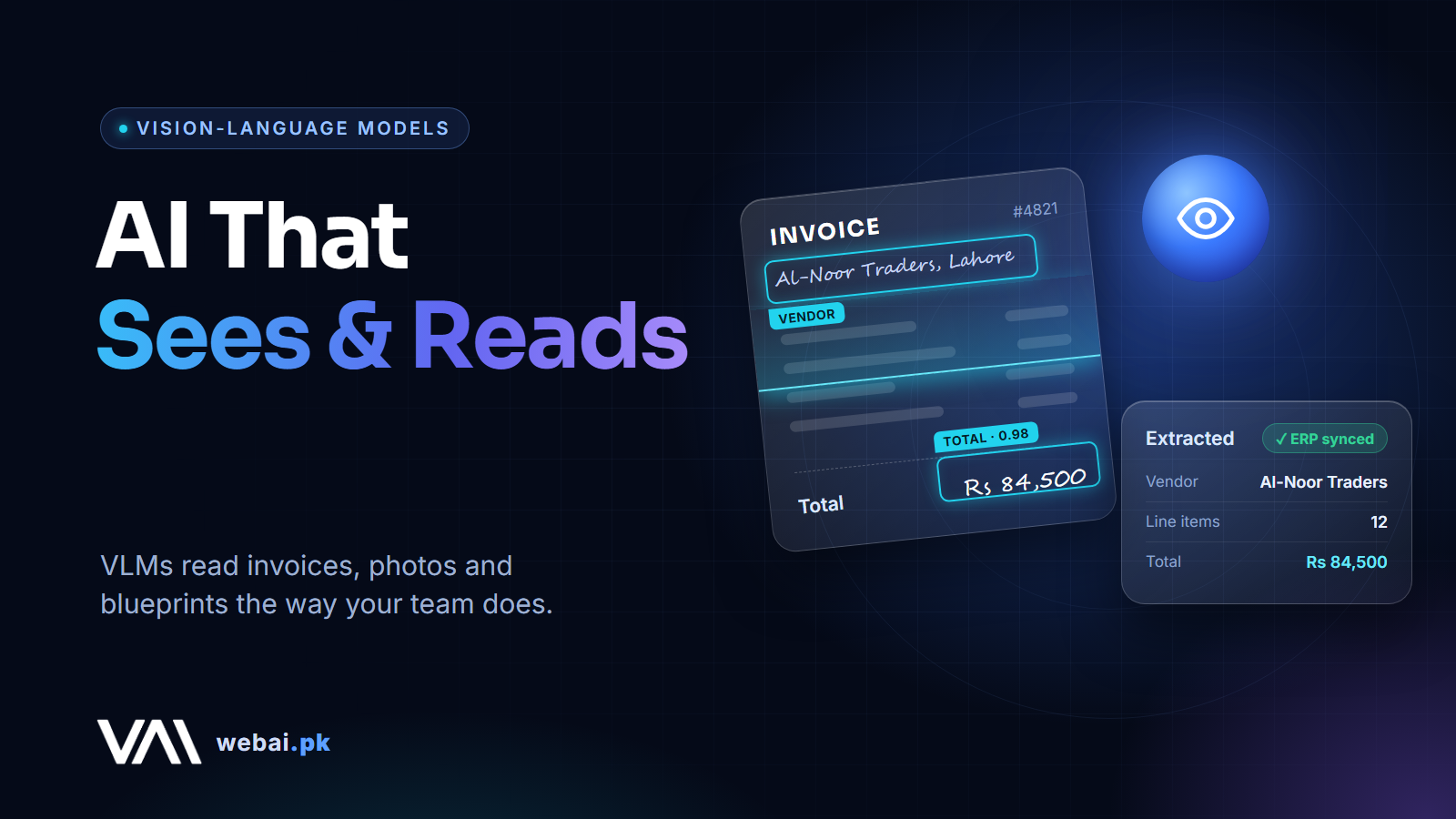
When you feed an image and a prompt into a VLM—such as asking it to inspect an invoice or evaluate an X-ray—the model does not just extract text strings. It comprehends spatial relationships, colors, handwriting styles, charts, and contextual cues. At WebAI Systems, we deploy VLMs for clients across Lahore and internationally to solve complex workflow problems that require both human-like sight and reading comprehension.
Core Business Use Cases for VLMs
Integrating visual intelligence into your enterprise software unlocks automation capabilities that were previously impossible with text-only AI agents. Here are the primary ways businesses leverage VLMs today:
- Automated Document Processing (IDP): Traditional OCR struggles with messy layouts, handwritten tables, or mixed media invoices. VLMs read complex, unstructured documents, extract line items, and cross-reference them with your custom ERP system instantly.
- Visual Quality Control & Manufacturing: Instead of simple motion sensors, VLMs inspect high-resolution product photos on assembly lines, detecting microscopic defects and generating detailed text logs explaining why a specific unit failed quality standards.
- Multimodal Customer Support & WhatsApp Chatbots: Customers frequently send screenshots of error messages, damaged products, or handwritten receipts via WhatsApp. A VLM-powered chatbot can analyze the image, diagnose the issue, and respond intelligently in Urdu or English.
- Retail and Inventory Audits: Retailers can upload store shelf photos to an AI system. The VLM counts inventory levels, checks placement compliance, and identifies missing price tags without requiring specialized hardware scanners.
How VLMs Power RAG and Custom ERP Systems
Many organizations maintain vast repositories of manuals, architectural blueprints, engineering diagrams, and financial charts. Standard Retrieval-Augmented Generation (RAG) systems fail when critical information is locked inside visual schematics. By integrating VLMs into your RAG pipeline, your internal AI assistants can literally look at engineering blueprints alongside text manuals to answer complex technical queries.
Furthermore, embedding VLM capabilities directly into custom ERP software changes data entry entirely. Staff members can snap a picture of a delivery receipt with their smartphone, and the ERP automatically populates inventory logs, updates ledger entries, and flags discrepancies in seconds.
Implementing VLMs in Your Organization
Deploying a Vision-Language Model requires careful consideration of latency, data privacy, and infrastructure costs. Depending on your security requirements, you can deploy open-source models on local GPU infrastructure or integrate enterprise-grade multimodal APIs.
At WebAI Systems, we build custom AI agents, RAG engines, and WhatsApp automation workflows tailored to your operational needs. If your business handles heavy visual documentation or physical inventory, adopting a VLM strategy will dramatically reduce manual overhead and human error.
- #vlm
- #vision language model
- #ai agents
- #rag
- #computer vision
- #whatsapp automation