Real-Time Surveillance with Vision-Language Models
Discover how Vision-Language Models (VLMs) transform traditional camera systems into intelligent, real-time surveillance tools for business security.
Traditional security camera systems have a fundamental flaw: they record everything, but they understand nothing. Security teams in Pakistan and worldwide are drowning in terabytes of video footage, relying on human operators to watch multiple screens for hours. This approach leads to fatigue, missed incidents, and delayed responses. At WebAI Systems, we integrate Vision-Language Models (VLMs) directly into modern camera and ERP systems to change this paradigm, turning passive video feeds into active, intelligent security agents.
The Shift from Motion Detection to Semantic Understanding
Standard security cameras rely on basic pixel-based motion detection. If a shadow moves, a tree branch sways, or a stray cat wanders into the frame, the system triggers a false alarm. Over time, security personnel learn to ignore these alerts, creating a dangerous vulnerability.
Vision-Language Models bridge the gap between computer vision and human language. Unlike older convolutional neural networks that could only classify a pre-trained set of objects (like 'person' or 'car'), VLMs possess deep contextual awareness. They process video frames alongside natural language prompts, allowing them to understand complex scenes and behaviors in real time.
Key Use Cases for VLM-Powered Surveillance
Deploying VLMs in your camera infrastructure unlocks advanced automation capabilities that go far beyond basic recording:
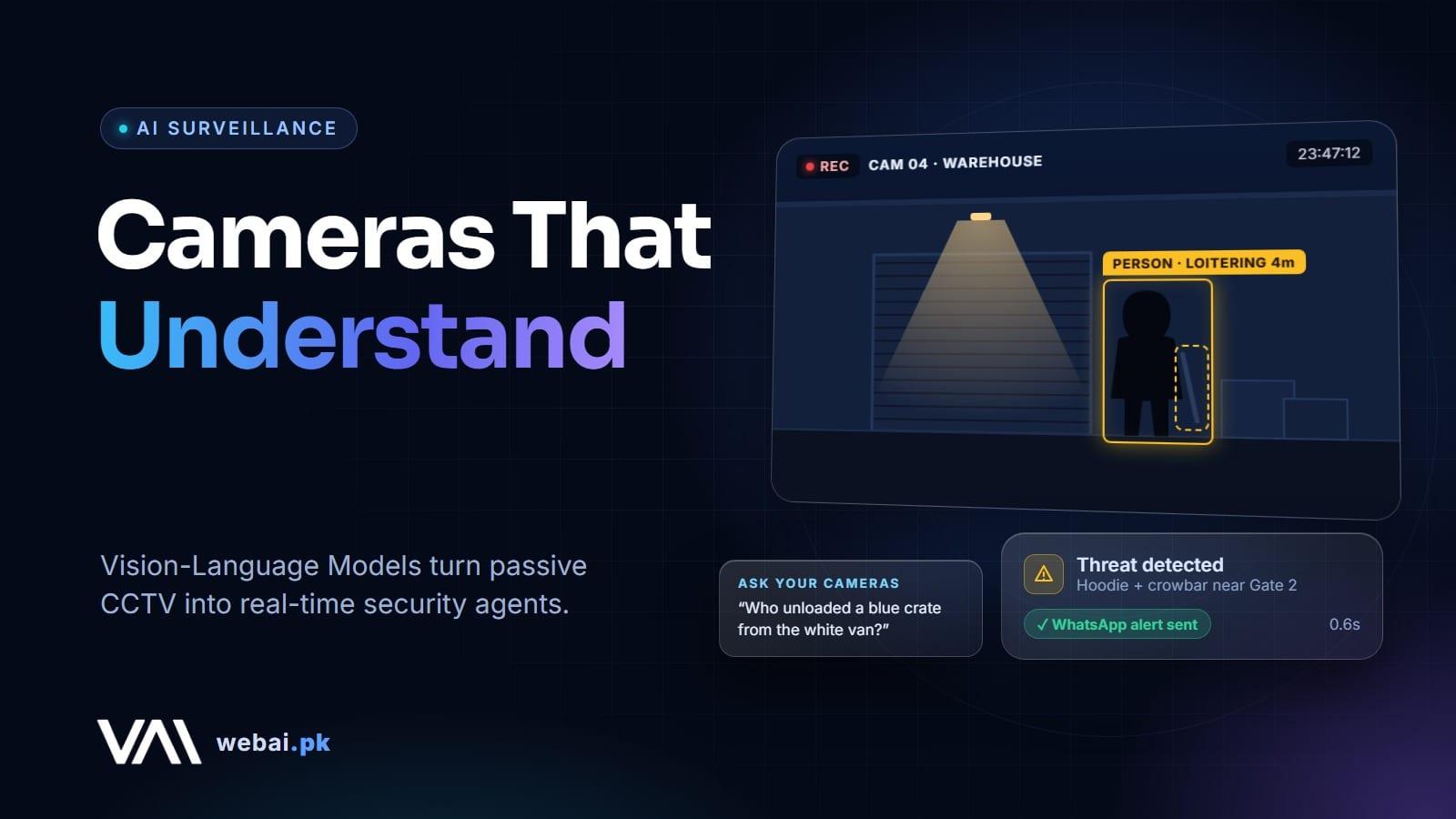
- Contextual Threat Detection: Instead of alerting on any movement, a VLM can detect specific scenarios, such as an individual lingering near a restricted warehouse door after hours while wearing a hoodie and carrying a crowbar.
- Automated Compliance Monitoring: In manufacturing plants and construction sites across Lahore and beyond, VLMs can instantly verify if workers are wearing mandatory PPE like helmets and safety vests.
- Retail Analytics and Loss Prevention: Retailers can track customer behavior patterns, identify prolonged lingering in high-value merchandise aisles, or flag suspicious concealment actions immediately.
- Natural Language Video Search: Security teams no longer need to manually scrub through eight hours of footage. They can simply query the system using plain text, such as: Show me all clips from camera 4 yesterday afternoon where someone unloaded a blue crate from a white van.
Architecture and Implementation: How We Build It
Integrating VLMs into existing CCTV or IP camera setups requires a robust, scalable architecture. At WebAI Systems, we design full-stack software solutions that connect local camera streams with high-performance AI processing units.
First, the video stream is ingested via RTSP or WebRTC protocols. Key frames are sampled intelligently to optimize bandwidth and processing costs—not every single frame requires heavy VLM inference. When an event of interest or an anomaly is detected, the system triggers an immediate alert via WhatsApp automation or integrates directly into your custom ERP to log an incident report.
Depending on your data privacy requirements and infrastructure budget, these models can be deployed locally on edge hardware (such as NVIDIA Jetson clusters) or hosted in secure cloud environments. Local deployment ensures zero latency and absolute data privacy, which is critical for sensitive industrial or financial facilities.
Overcoming Implementation Challenges
While the benefits are immense, deploying VLMs for real-time surveillance requires careful engineering. Processing video through large multimodal models is computationally intensive. To achieve true real-time performance (sub-second latency), we utilize model quantization, specialized hardware acceleration, and smart frame-sampling algorithms that only send high-complexity frames to the heavy VLM.
Another consideration is lighting and weather conditions. Pakistani operational environments often feature harsh sunlight, dust, or low-light night conditions. We fine-tune preprocessing pipelines to ensure that the visual inputs remain clear enough for accurate semantic interpretation by the model.
Conclusion: The Future of Intelligent Infrastructure
Real-time surveillance is no longer just about recording video; it is about extracting actionable intelligence the exact moment an event occurs. By combining custom web applications, automated alerting, and Vision-Language Models, businesses can drastically reduce security overhead and response times.
If you are looking to upgrade your surveillance infrastructure with cutting-edge AI agents and custom software integration, contact WebAI Systems today to discuss how we can build a tailored solution for your organization.
- #vision language models
- #ai surveillance
- #computer vision
- #security automation
- #edge ai
- #webai systems