Interconnects in Modern AI: Overcoming the GPU Bottleneck
Discover how high-speed hardware interconnects like NVLink and InfiniBand solve the massive data transfer bottlenecks in modern AI infrastructure.
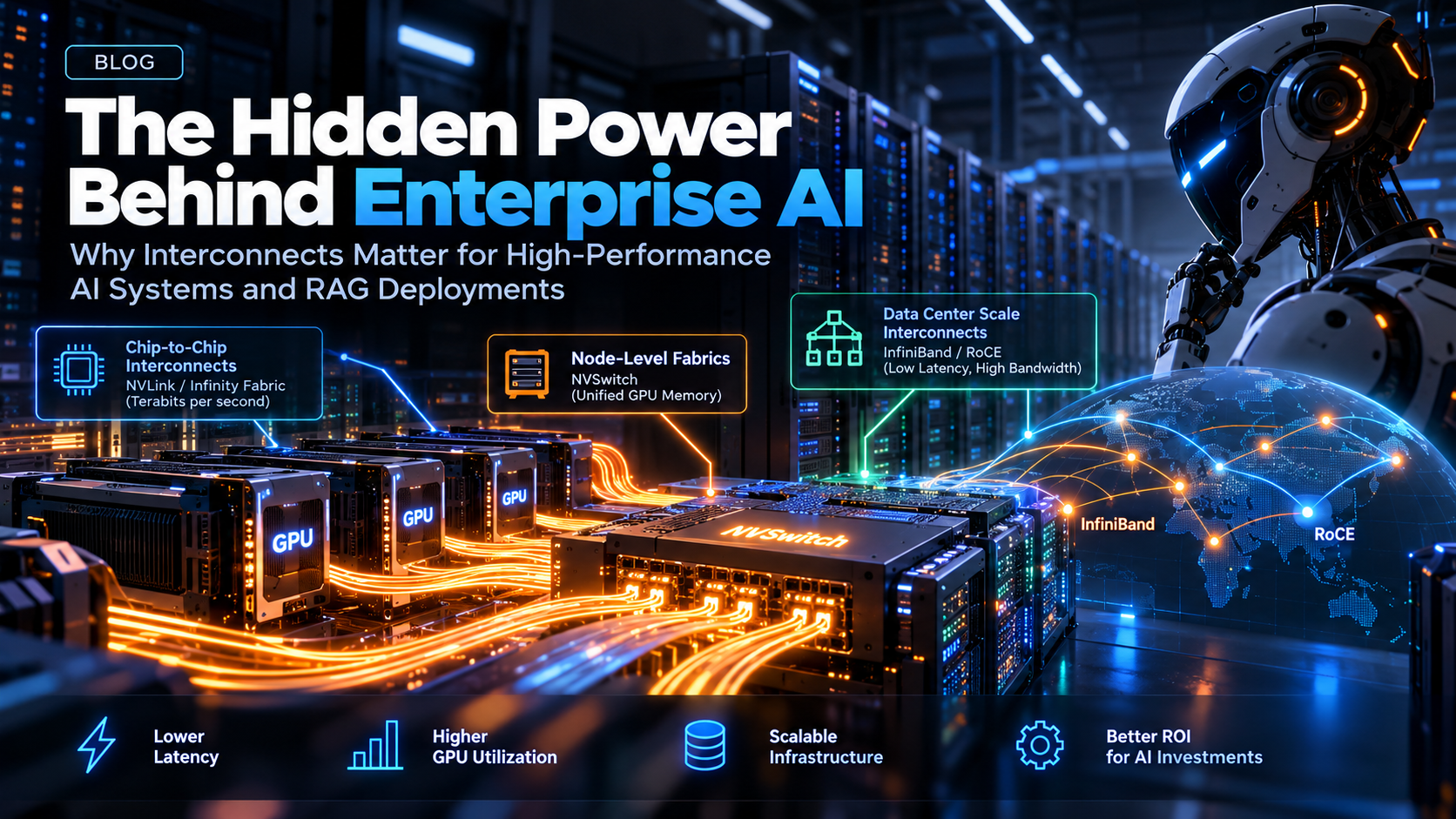
When business leaders and technical decision-makers evaluate enterprise AI infrastructure, the conversation almost always starts with raw compute power. We obsess over GPU models, floating-point operations per second, and model parameter sizes. Yet, as companies scale their large language models and retrieval-augmented generation pipelines, a silent killer of performance emerges: the interconnect.
An interconnect is the physical and logical communication highway linking microprocessors, memory banks, and entire server nodes. Without ultra-fast interconnects, even a cluster of thousands of the world's most advanced GPUs will sit idle, starved of data. At WebAI Systems, when we architect high-throughput custom AI systems and RAG knowledge bases for demanding enterprise workloads, designing the interconnect topology is just as critical as selecting the model architecture.
The Core Problem: Why GPUs Need Interconnects
Modern generative AI models are simply too massive to fit into the memory of a single graphics processing unit. A standard 70-billion parameter model requires tens of gigabytes of VRAM just to load weights, let alone execute inference or training passes. To overcome this, engineers split workloads across clusters of accelerators using parallelism techniques like tensor parallelism and pipeline parallelism.
This is where interconnects become vital. As the model splits across multiple processors, those processors must constantly synchronize their states, exchange gradient updates, and pass intermediate tensor activations. If the communication link between chip A and chip B is slow, chip A finishes its mathematical calculation in microseconds but wastes milliseconds waiting for data from chip B. This delay is known as communication latency, and it destroys overall system throughput.
Key Interconnect Technologies Driving Enterprise AI
To eliminate these bottlenecks, hardware manufacturers have developed specialized high-bandwidth interconnect standards operating at multiple tiers of an AI infrastructure stack.
1. Chip-to-Chip and Die-to-Die Interconnects
Inside a single modern AI accelerator package, multiple compute dies communicate over ultra-dense microscopic traces. Standards like NVLink in NVIDIA architectures or AMD's Infinity Fabric provide terabits per second of bidirectional bandwidth directly between GPUs on the same board, bypassing the slower system motherboard buses entirely.
2. Node-Level Fabrics
Within a single rack of servers containing eight or more GPUs, systems utilize high-speed switches. NVIDIA's NVSwitch fabric, for example, allows every GPU in a multi-node chassis to communicate with every other GPU at maximum native speed, creating a unified memory space where multiple physical chips act almost like a single giant processor.
3. Data Center Scale Interconnects: InfiniBand vs. Ethernet
When training massive foundational models across thousands of servers, rack-to-rack communication becomes the primary challenge. Here, engineers choose between two primary networking paradigms:
- InfiniBand (IB): Historically preferred for high-performance computing and AI clusters due to its extremely low latency, hardware-offloaded transport, and remote direct memory access (RDMA) capabilities.
- RoCE (RDMA over Converged Ethernet): A cost-effective alternative that brings ultra-low latency RDMA packet handling over standard enterprise Ethernet infrastructure, making it increasingly popular for scalable enterprise data centers.
How Interconnect Bottlenecks Impact Business AI Deployments
You might wonder how hardware interconnects affect standard enterprise applications like WhatsApp automation agents, customer support chatbots, or localized RAG systems deployed for Pakistani and international clients. The impact is direct and financial:
Inference Latency: When a customer submits a complex query to an enterprise knowledge base, the system retrieves relevant documents and feeds them into an LLM. If the internal server interconnects are congested or underpowered, time-to-first-token increases, leading to sluggish user experiences.
Infrastructure Costs: Inefficient interconnects lead to lower GPU utilization rates. If your accelerators spend half their clock cycles waiting for data transfer across poorly configured networks, you are essentially paying double for your cloud compute footprint.
Scalability Limits: As your business data grows and you need to scale up your custom ERP integrations or real-time data pipelines, a poorly chosen network topology creates an immediate ceiling that halts further growth without a complete infrastructure overhaul.
Best Practices for Architecting AI Hardware Infrastructure
Optimizing interconnects requires a deliberate, engineering-first approach. Whether you are building an on-premise AI cluster or provisioning cloud instances through AWS, Azure, or specialized GPU clouds, keep these guidelines in mind:
- Match Topology to Workload: Heavy model training requires full-mesh NVLink topologies to support massive all-reduce operations. Inference-heavy workloads can often utilize more cost-effective PCIe switch architectures with high-speed Ethernet backbones.
- Prioritize RDMA: Never rely on standard TCP/IP networking stacks for distributed AI training or high-load RAG pipelines. Ensure your cluster uses RDMA (RoCE or InfiniBand) to allow direct memory transfers between GPUs without CPU intervention.
- Work with Experienced System Integrators: Designing balanced hardware architectures that harmonize compute, memory, storage, and networking requires specialized expertise. At WebAI Systems, we help enterprises bridge the gap between software capability and underlying hardware realities, ensuring your custom AI deployments run at peak performance from day one.
As AI models continue to grow larger and enterprise integration becomes more complex, understanding the invisible highways of your infrastructure is no longer optional. By paying close attention to interconnect design, organizations can eliminate latency, maximize ROI on expensive hardware investments, and deliver lightning-fast AI solutions to their end users.
- #interconnects
- #gpu architecture
- #ai infrastructure
- #nvlink
- #infiniband
- #enterprise ai
- #hardware bottlenecks