GPT-6 Astra and the AGI Debate: Enterprise Reality vs Hype
Frontier models like GPT-6 and Astra fuel intense debate around AGI. Here is what upcoming autonomous capabilities actually mean for enterprise engineering.
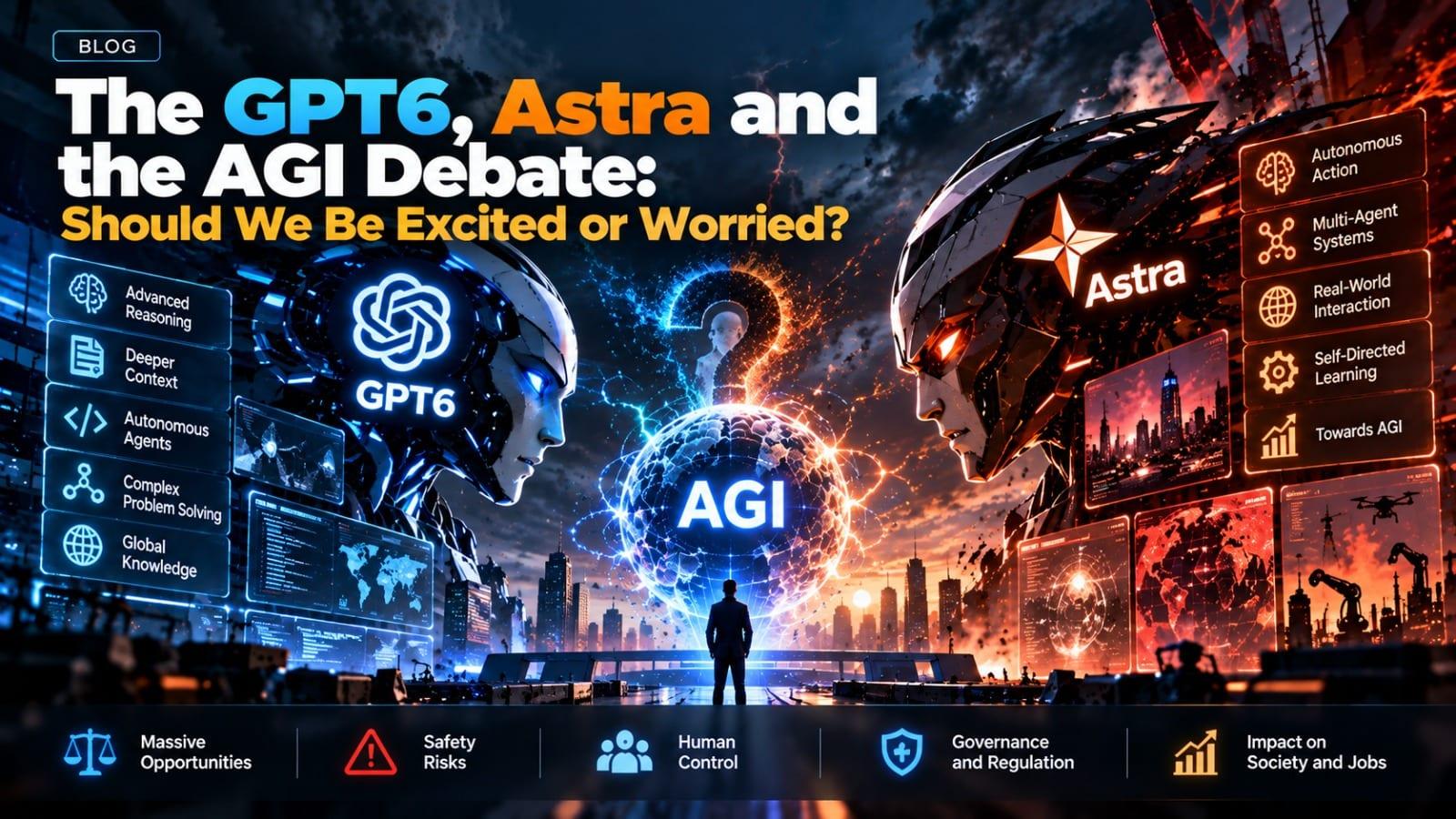
Speculation surrounding next-generation frontier intelligence—often referenced in research circles under codenames like Astra or roadmapped toward GPT-6—has reignited the debate over Artificial General Intelligence (AGI). Tech luminaries argue over timelines ranging from eighteen months to two decades, while benchmark leaderboards constantly shift under the weight of chain-of-thought reasoning and multimodal perception. Yet for business leaders, Chief Technology Officers, and software architects, the conversation around AGI frequently misses the practical mark. The defining question for enterprise operations is not when a machine will develop self-directed consciousness, but how rapidly evolving reasoning models alter the architecture of real-world software, autonomous workflows, and system reliability.
Understanding the Shift: From Pattern Matching to Agentic Execution
To evaluate what GPT-6-class systems and multimodal initiatives like Project Astra signify, we must look past marketing terms. Early large language models operated primarily as probabilistic text generators. They calculated the next most statistically probable token based on massive pretraining corpora. While remarkable for drafting emails, summarizing text, or answering queries, these systems lacked internal verification, dynamic memory, and the capacity to execute multi-step operational loops reliably.
The current trajectory leading toward GPT-6 and Astra is characterized by three fundamental architectural shifts:
- Continuous Multimodal Perception: Moving beyond episodic prompts to real-time video, audio, and sensor streaming. Models do not merely evaluate a static JPEG; they process continuous operational environments, user interactions, and visual interfaces in real time.
- Test-Time Compute and Search: Instead of immediate token generation, frontier reasoning models utilize compute at inference time to plan, back-track, evaluate alternatives, and verify logic before delivering an output.
- Native Agentic Tool Use: Systems are being trained from the ground up to manipulate software environments, call APIs, write and execute code in sandboxes, and inspect error logs when failures occur.
These capabilities bring models closer to what researchers classify as level-two or level-three AGI: systems capable of autonomous problem-solving and long-horizon project execution within complex, ambiguous environments.
The AGI Benchmark Dilemma: Lab Scores vs. Production Uptime
A critical source of confusion in executive boardrooms is the divide between benchmark performance and enterprise reliability. A model scoring 90% on SWE-bench or outperforming PhDs on competitive mathematics benchmarks sounds ready to replace software departments and back-office teams overnight. In practice, production environments have an unforgiving margin for error that academic evaluations do not capture.
Consider an enterprise Resource Planning (ERP) database reconciliation or a automated trade finance workflow in Lahore or Dubai. If an autonomous model operates with a 95% accuracy rate, it sounds extraordinary by academic metrics. However, in an operation handling 20,000 ledger transactions or customs declarations weekly, a 5% failure rate translates to 1,000 catastrophic hallucinations, misrouted payments, or inventory mismatches every seven days. In mission-critical software, 95% accuracy is a structural failure.
This discrepancy explains why the debate over whether GPT-6 qualifies as "AGI" is mostly irrelevant to commercial software engineering. A system does not need philosophical general intelligence to transform a company; it needs deterministic guardrails, structured memory systems, and rigorous orchestration that convert raw probabilistic intelligence into deterministic operational output.
The Enterprise Stack Required to Harness Frontier Models
No matter how capable GPT-6, Astra, or open-weight competitors become, frontier intelligence cannot function as a standalone enterprise product. A raw model endpoint does not know your company's credit policies, your warehouse stock levels, your customer pricing tiers, or your security compliance rules. Deploying real autonomy requires an engineering layer designed to anchor foundation models in ground truth.
1. Deterministic Knowledge Retrieval (Advanced RAG)
Enterprise data is dynamic, proprietary, and distributed across SQL databases, unstructured PDF manuals, ERP ledgers, and CRM records. Simply feeding frontier models a massive context window does not solve context drift or out-of-date retrieval. Resilient architectures rely on hybrid Retrieval-Augmented Generation (RAG)—combining dense vector embeddings, BM25 keyword matching, and knowledge graph relationships to verify facts before the model synthesizes a decision.
2. Multi-Agent Orchestration with State Machines
Monolithic prompts fail when tasks span hours or days. The path toward deploying frontier models involves decomposing complex business objectives into discrete agent roles governed by finite state machines. In our engineering work at WebAI Systems, we separate high-level planning agents from deterministic execution agents. If an autonomous system is tasked with onboarding an enterprise client, one agent parses compliance documents, another queries sanctions databases, and a third updates the internal ERP. The system's state is preserved externally in transactional databases, ensuring operations can pause for human approval, recover from dropped network connections, and audit every step.
3. Sandboxed Execution and Fine-Grained Guardrails
As models gain the ability to write code and call system APIs, security becomes the paramount architectural concern. Autonomous agents cannot be granted unrestricted network access or raw database credentials. Enterprise deployments require ephemeral execution environments—micro-containers that spin up to execute an agent-generated Python script, validate the output schema, and terminate immediately without exposing production infrastructure.
Why Waiting for AGI is an Expensive Strategic Mistake
A common misstep among executives is postponing AI implementation until frontier models "settle down" or until AGI officially arrives. The premise is flawed: waiting for an all-knowing, self-configuring AI ignores how technological value is actually captured in the modern economy.
The organizations dominating their sectors today are not waiting for GPT-6. They are systematically modernizing their data pipelines, exposing clean internal APIs, digitizing legacy paper-based workflows, and deploying specialized automation agents across high-friction touchpoints. When a breakthrough model like Astra or GPT-6 is released, an organization with modern API-first infrastructure can swap out its underlying foundation model in an afternoon, immediately gaining an order-of-magnitude leap in speed and capability. Conversely, a business running disconnected spreadsheets, on-premise silos with zero API access, and unstructured workflows cannot benefit from frontier models regardless of how intelligent the models become.
Strategic Recommendations for Technical Leaders
To prepare your enterprise for the emergence of GPT-6-class reasoning engines and agentic architectures, focus on the structural layers within your control:
- Audit Data Accessibility: Ensure your core business intelligence—from inventory management to customer support history—is accessible via secure, authenticated REST or GraphQL endpoints. Models interact through tools; if your data has no programmatic handle, an agent cannot interact with it.
- Implement Pragmatic Task Boundaries: Focus automation on workflows with well-defined inputs, structured outputs, and measurable success criteria. Automated customer communication over WhatsApp, automated accounts-payable matching, and programmatic document extraction are proven high-ROI starting points.
- Design for Model Agnosticism: Avoid building systems tied strictly to a single proprietary provider. Abstract your agent frameworks so that reasoning backends can be dynamically routed between OpenAI, Anthropic, Google, or local open-weights based on latency, cost, and data sovereignty requirements.
- Prioritize Auditability over Full Autonomy: Implement human-in-the-loop triggers for high-consequence operational decisions. Allow the agent to draft, calculate, verify, and package recommendations, while reserving final operational commitments for human team members until reliability reaches mathematical certainty.
The philosophical debate over AGI will continue to capture public imagination, but engineering leaders must remain grounded in architectural reality. The true competitive advantage does not stem from speculating on when artificial superintelligence will appear. It belongs to the builders who construct resilient, agent-ready enterprise systems capable of converting frontier reasoning into sustained business value today.
- #agi
- #gpt-6
- #ai agents
- #frontier models
- #enterprise ai