Best AI Models in 2026: ChatGPT, Gemini, Claude, and Grok Compared
A technical evaluation of OpenAI, Google, Anthropic, and xAI models in 2026 to help enterprise leaders select the right LLM for production agents and workflows.
Enterprise AI deployments in 2026 have moved far beyond generic conversational chatbots. Technical teams and business operators no longer evaluate large language models (LLMs) on their ability to write polite emails; they evaluate them on deterministic tool calling, multi-step reasoning reliability, token latency, context recall fidelity, and cost per million tokens. Selecting an AI provider is now an infrastructure architecture decision that directly affects your software uptime, unit economics, and data sovereignty.
The Core Contenders: Where the AI Frontier Sits Today
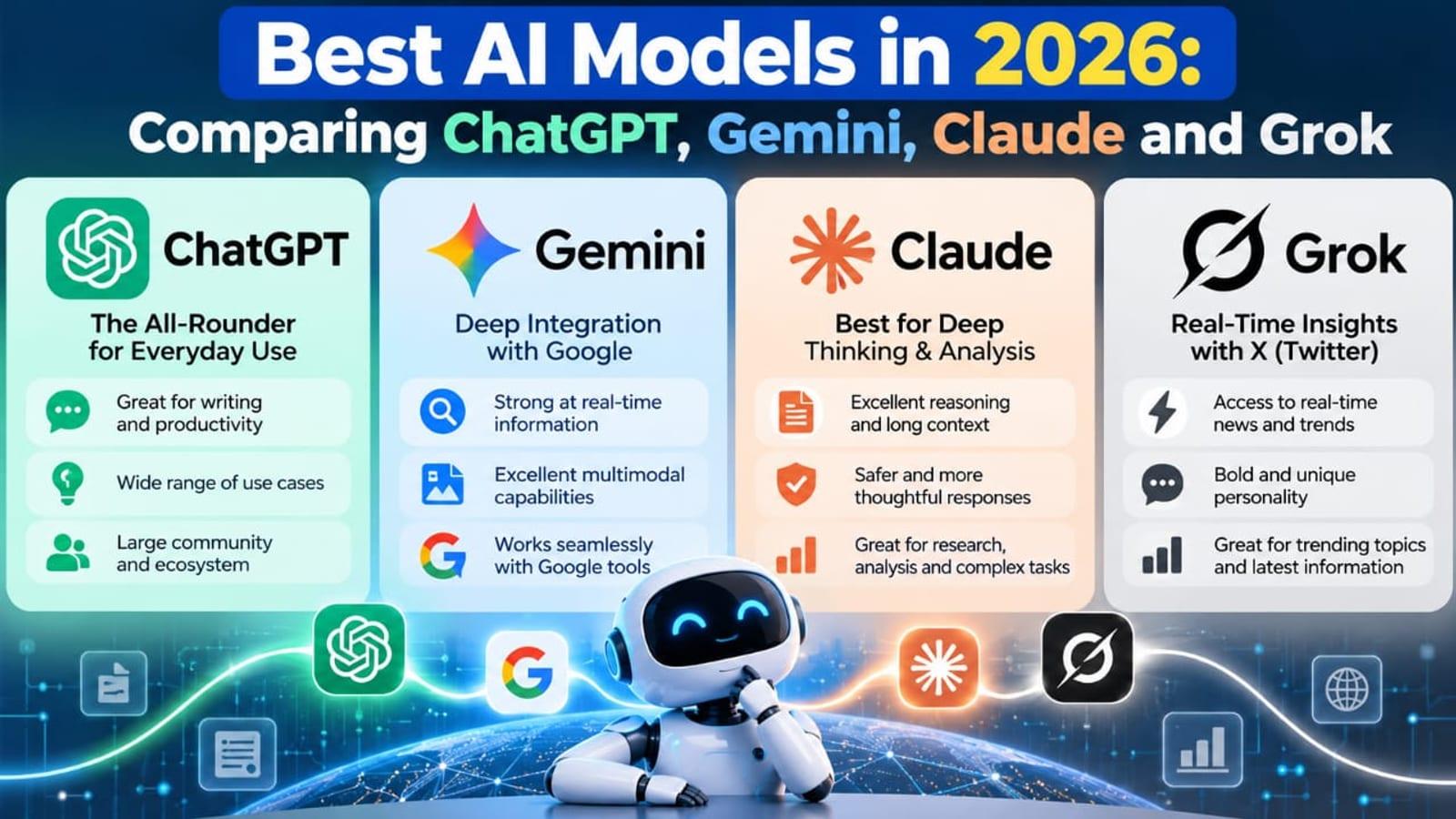
Four major frontier lab ecosystems dominate enterprise adoption: OpenAI, Anthropic, Google DeepMind, and xAI. Each has diverged into distinct engineering philosophies and specialized strengths. Understanding where each model excels lets companies avoid expensive refactors when moving prototypes into live customer or backend systems.
1. OpenAI (GPT-4o, o3, and Next-Gen Reasoning)
OpenAI remains the industry benchmark for complex autonomous agents and ecosystem integrations. Their dual-track approach—pairing fast multimodal models like GPT-4o with dedicated chain-of-thought reasoning models like the o-series—gives engineering teams a predictable operational ladder. If an agent needs to execute high-speed API calls or handle basic voice conversations, the multimodal track delivers low latency. When an agent must analyze contradictory balance sheets or debug multi-file software repositories, the reasoning track provides mathematical precision.
Strengths:
- Industry-standard function calling and structured JSON output enforcement.
- Broadest native integration across middleware, vector databases, and developer frameworks.
- Advanced step-by-step reasoning that drastically reduces logical failures in automated workflows.
Drawbacks: High peak token pricing for top-tier reasoning tiers and strict rate-limiting policies during high-traffic global windows.
2. Anthropic Claude (Claude 3.5 / 3.7 Series)
Anthropic has established itself as the enterprise standard for production software engineering, complex system prompt adherence, and nuance. Software teams consistently find that Claude generates cleaner, production-ready code with fewer defensive patches than its competitors. Moreover, Claude exhibits the highest resistance to prompt injection attacks, making it a favorite for public-facing automated channels like WhatsApp business agents or financial customer portals.
Strengths:
- Superb coding generation, refactoring, and automated debugging across enterprise codebases.
- Unmatched adherence to strict system instructions and negative constraints (e.g., "never reveal X").
- Exceptional document synthesis that processes complex contracts without hallucinating clauses.
Drawbacks: Smaller native ecosystem of plugins compared to OpenAI, requiring custom orchestration layers for specialized integrations.
3. Google Gemini (Gemini 2.0 Pro and Flash)
Google has capitalized on its proprietary hardware infrastructure (TPUs) to make Gemini the definitive leader in raw context volume and multimodal processing. With reliable multi-million token context windows, Gemini allows businesses to bypass vector search entirely for medium-sized document sets, ingesting full manuals, hours of video, or entire codebase histories directly into the prompt cache.
Strengths:
- Massive native context processing with near-perfect needle-in-a-haystack retrieval performance.
- Extremely cost-effective "Flash" models designed for high-throughput, low-latency background processing.
- Native multimodal capabilities that process audio, high-resolution imagery, and video in real time.
Drawbacks: Inconsistent JSON schema compliance on smaller models when executing nested, interdependent tool-calling routines.
4. xAI Grok (Grok 2 and Grok 3)
xAI has built a serious enterprise contender powered by the Colossus supercluster. Grok differentiates itself through unvarnished data extraction, high-speed mathematical analysis, and continuous ingestion of real-time streaming information. For financial intelligence, live market telemetry, and open-ended research pipelines, Grok provides an alternative free from overly cautious safety filters that frequently derail technical data extraction in other models.
Strengths:
- Direct access to real-time unstructured data streams and dynamic event tracking.
- Aggressive compute allocation yielding state-of-the-art competitive performance on hard math and scientific benchmarks.
- Lower baseline refusal rates on ambiguous enterprise queries and security audits.
Drawbacks: Nascent enterprise governance tooling, fewer enterprise compliance certifications (e.g., HIPAA/SOC2 pipelines), and a less mature developer API infrastructure.
Production Workload Matchups: How to Choose
Choosing an LLM based on generic benchmarks is a common mistake. The right choice depends entirely on your specific workload architecture:
Enterprise RAG and Legal Audit
Winner: Anthropic Claude & Google Gemini
When cross-referencing thousands of regulatory filings, trade invoices, or local legal statutes, Claude delivers unmatched precision in citation and contextual interpretation. If your application requires scanning continuous hours of video recordings or large technical PDF archives in a single query, Gemini Pro’s massive context window removes the fragmentation issues inherent to basic chunk-based RAG pipelines.
High-Volume WhatsApp & Customer Support Automation
Winner: Claude Haiku & Google Gemini Flash
For consumer communication over WhatsApp or web widgets—especially in fast-moving commercial markets like Pakistan and the Middle East—response latency and token costs dictate profitability. Gemini Flash and Claude Haiku maintain conversation state, follow localization guidelines (such as parsing Roman Urdu mixed with English), and execute downstream ERP lookups in under 800 milliseconds at fractions of a cent per conversation.
Autonomous ERP Agents and System Integration
Winner: OpenAI (GPT-4o / o-Series)
When an agent must interpret natural language from an operations manager, cross-check stock levels in an inventory database, write an accounting voucher, and notify logistics vendors via webhook, OpenAI remains the most predictable orchestrator. Its strict structured JSON outputs eliminate database parsing errors that break production workflows.
The Multi-Model Routing Strategy
Sophisticated engineering teams no longer bind their core platforms to a single proprietary provider. At WebAI Systems, we design production architectures around dynamic model routing. A lightweight model (like Gemini Flash or Claude Haiku) categorizes inbound user intent; standard inquiries are answered instantly at rock-bottom cost. If the request requires multi-step database operations or deep analytical reasoning, the request escalates transparently to GPT-4o, Claude Sonnet, or an o-series model.
This multi-model routing reduces overall API expenditures by up to 60% while providing automatic fallback redundancy: if one provider experiences an infrastructure outage, your business applications automatically reroute requests to an alternative frontier model with zero operational downtime.
Summary Checklist for 2026 Implementations
- Audit your latency requirements: Real-time messaging needs sub-second response times; multi-step analytical reasoning can afford 10–20 seconds of compute time.
- Calculate true inference costs: Factor in token consumption across input, output, prompt caching, and reasoning tokens before choosing a frontier tier.
- Decouple your software: Use abstracted API layers so your ERP, agent workflows, and internal software can swap underlying models as benchmark leadership shifts.
The race between OpenAI, Anthropic, Google, and xAI guarantees continuous downward price pressure and rapid capability expansion. Winning teams are not the ones who bet exclusively on one brand, but those who build agile software foundations capable of putting each model to work where it delivers measurable commercial returns.
- #artificial intelligence
- #chatgpt
- #claude
- #gemini
- #grok
- #llm comparison
- #enterprise ai