AI Agents in 2026: Practical Business Capabilities
Move past the hype. Discover what autonomous AI agents actually accomplish across ERPs, WhatsApp workflows, finance, and operations in 2026.
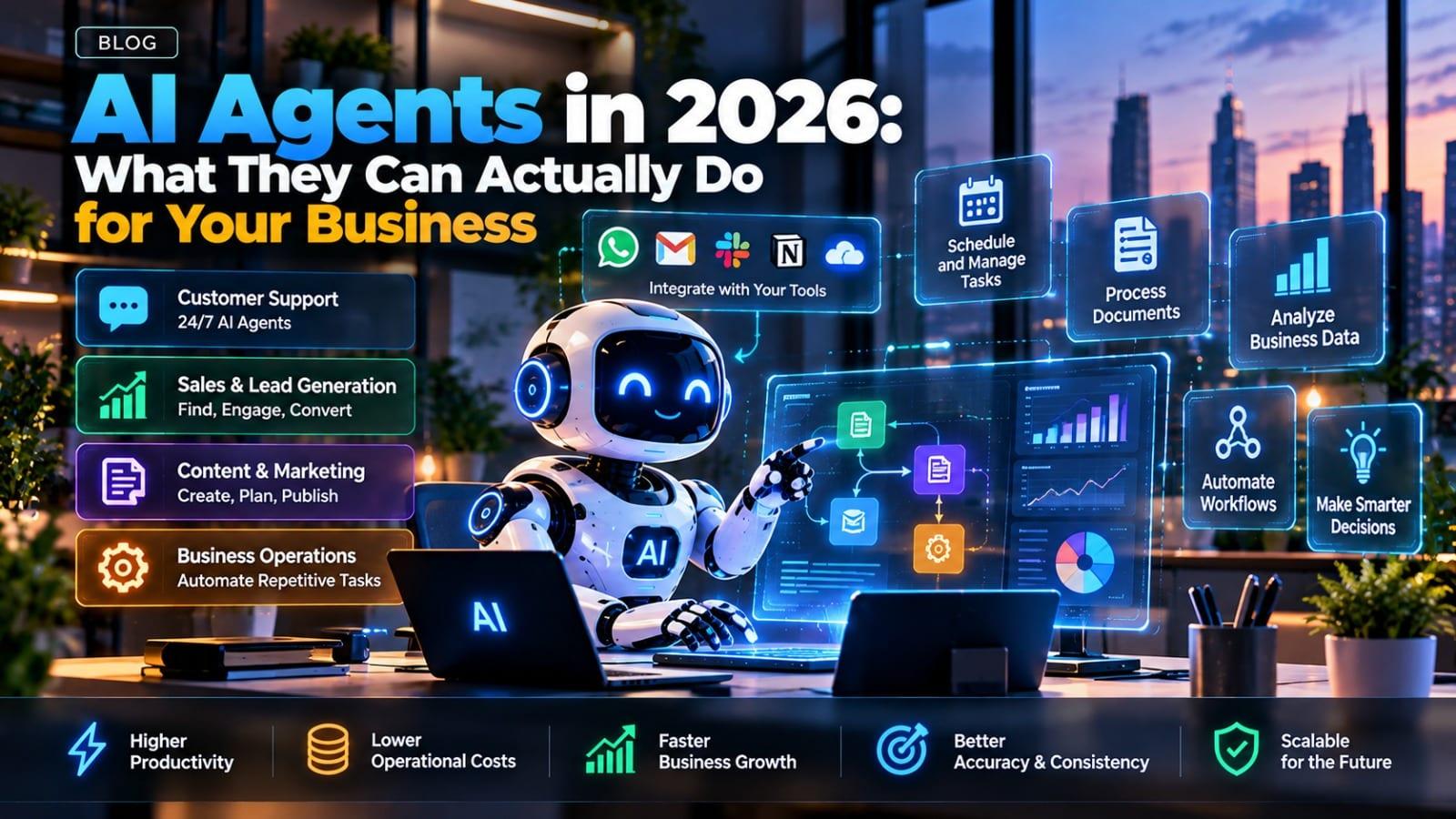
Between 2023 and 2025, enterprise AI was largely defined by conversational chatbots and static Retrieval-Augmented Generation (RAG) pipelines. Companies deployed systems that could answer questions based on internal documents, but taking action still required a human clicking through tabs, verifying data, and entering records into software. In 2026, the paradigm has shifted from passive information retrieval to agentic execution. AI agents now function as asynchronous digital workers capable of multi-step planning, tool orchestration, and cross-system database modification.
The Core Anatomy of a Modern AI Agent
An AI agent is not simply a large language model answering prompts. It is an autonomous software system structured around four foundational components:
- Perception and Event Listeners: Rather than waiting for a chat interface submission, modern agents listen to webhooks, database changes, inbound emails, and messaging protocols like the WhatsApp Business API.
- Planning and Decomposition: When given an objective—such as reconciling an unallocated bank deposit—the agent breaks down the problem into sequential logic: query bank statements, search pending invoices in the ERP, compare tax identifiers, and identify discrepancies.
- Tool Execution: The agent holds authenticated access to internal APIs, SQL databases, file systems, and external vendor portals. It converts decisions into structured JSON payloads or direct database transactions.
- Memory and State Persistence: Agents utilize hybrid memory architectures. They combine short-term execution memory (tracking current task states in Redis or Temporal) with long-term semantic memory (vector embeddings and relational historical records).
High-Value Business Use Cases Operating Today
Enterprises are deploying AI agents across operational verticals where routine data entry, manual cross-referencing, and multi-platform coordination consume significant payroll hours.
1. Autonomous WhatsApp and Omnichannel Commerce
In regions like Pakistan, the Middle East, and Latin America, commerce runs on WhatsApp. Traditional chatbots rely on rigid decision trees that break when a customer deviates from scripted inputs. Modern commerce agents manage end-to-end purchasing cycles with conversational flexibility.
An agent integrated with a local retail ERP can parse unstructured text, voice notes, and low-resolution product photos. When a customer sends a photo of an industrial valve or an apparel item alongside a Roman Urdu voice note asking for availability, the agent transcribes the audio, runs an image vector similarity search against the product catalog, checks inventory across regional warehouses, calculates shipping fees, and generates an instant checkout link or cash-on-delivery order confirmation directly inside the database.
2. Financial Audit and Automated Reconciliation
Month-end closing traditionally requires accounts teams to cross-reference bank statements against ERP ledgers, physical receipts, and vendor invoices. Human error and delay are common.
Financial agents connect directly to bank feed APIs, optical character recognition (OCR) parsers, and custom ERP systems. When an incoming payment arrives without an invoice number, the agent scans open receivables, checks buyer tax numbers, flags subtle price variances caused by withholding taxes or currency fluctuations, posts the journal entry, and drafts an exception notification to the head of finance only when certainty falls below an established confidence threshold.
3. B2B Procurement and Vendor Operations
Procurement teams regularly balance vendor price lists, stock minimums, and purchase order lifecycles. Agentic procurement workflows monitor inventory thresholds in real time. When raw materials reach a safety limit, the agent drafts and sends requests for quotations (RFQs) to three pre-approved vendors via email or vendor portal.
As replies arrive, the agent extracts unit pricing, lead times, and payment terms, compiles a side-by-side comparison matrix, highlights the best operational choice, and routes the approval request directly to the procurement director via Slack, Teams, or WhatsApp. Once approved with a single click, the agent posts the purchase order to the ERP and schedules receipt tracking.
Pakistan and Emerging Markets: Navigating Infrastructure Realities
Deploying AI agents in emerging markets like Pakistan comes with specific engineering challenges that off-the-shelf Western SaaS tools fail to address. Real-world implementations must account for:
- Linguistic Fluidity: Operating successfully requires models tuned to parse code-switched languages, including Roman Urdu, regional colloquialisms, and inconsistent spelling across customer communications.
- Fragmented Legacy Architectures: Many mid-market manufacturers and distributors run on legacy on-premise databases without standardized REST APIs. Enterprise agents must be built with resilient middleware that translates agentic intent into raw SQL queries, flat-file exports, or local ODBC connections.
- Payment Gateway Nuances: Unlike markets dominated by Stripe, workflows in Pakistan require coordination across 1Link, Raast, local digital wallets, and manual bank transfer receipts. Agents must inspect transaction IDs, verify screenshot payment proofs using vision models, and reconcile balances before updating fulfillment queues.
Architecture: Balancing Determinism and Probabilistic Reasoning
The primary barrier to deploying AI agents in high-stakes environments is hallucination. Business leaders cannot allow an unbounded language model to write directly to production ledgers without constraints. Production-grade agentic systems solve this through rigorous software architecture:
Deterministic Guardrails
Agents do not directly execute arbitrary SQL queries against production environments. Instead, they interact with strictly defined API contracts. The model determines which tool to call and extracts the required parameters, but the tool itself executes hard-coded, validated business logic. If an agent tries to apply an unauthorized discount exceeding 15%, the API layer rejects the transaction regardless of the agent's reasoning.
Human-in-the-Loop (HITL) Routing
Enterprise systems incorporate confidence scoring and deterministic checkpoints. Tasks involving high monetary values, irreversible data deletions, or policy edge cases trigger an interrupt state. The agent compiles its chain of reasoning, attaches relevant records, and assigns a review ticket to human staff. Once the human confirms or adjusts the action, the agent resumes execution.
State Machines and Durable Execution
Long-running agent workflows can span hours or days—for example, awaiting a customer document or vendor confirmation. Modern agent deployments leverage durable execution frameworks like Temporal or Celery state managers. If an API times out or a server restarts mid-task, the agent picks up precisely at its last confirmed step without repeating actions or corrupting data.
How to Prepare Your Infrastructure for AI Agents
Organizations aiming to operationalize AI agents in 2026 must focus on systemic data hygiene and operational readiness before purchasing agentic platforms:
- Consolidate System Interfaces: If your team updates inventory in an Excel sheet and customer data in an isolated CRM, an agent cannot bridge the gap reliably. Build or adopt unified APIs across your core business operations.
- Document Implicit Operating Procedures: Agents require unambiguous instructions. If your team cannot explain in writing how invoice disputes are evaluated, an AI agent cannot execute the process reliably.
- Start with Read-Only Workflows: Before granting write permissions to an agent, run it in an observational mode. Let it observe inbound events, draft the response or transaction, and log its recommendations. Once operational accuracy hits 98% across hundreds of test cases, transition to autonomous execution with human-in-the-loop fallback.
AI agents have moved beyond experimental research. When anchored to robust ERP backbones, validated APIs, and clear business rules, they represent the single most impactful infrastructure investment an enterprise can make to scale output without linearly scaling headcount.
- #ai agents
- #automation
- #enterprise ai
- #rag
- #erp
- #whatsapp automation