AI Agent Guardrails: Secure Your Business Automation
Learn how to secure your business automation with essential AI agent guardrails, least privilege access, and human-in-the-loop workflows.
Deploying autonomous systems can radically transform your operations, but it also introduces unique risks. When you deploy autonomous software to handle customer data, process transactions, or interact with enterprise databases, you cannot rely solely on the base model's built-in safety prompts. Implementing robust AI agent guardrails is no longer optional for businesses scaling their automation infrastructure. Without clear boundaries, autonomous software can hallucinate actions, expose sensitive customer records, or execute unintended database modifications.
Why You Need AI Agent Guardrails Today
As companies across Pakistan and globally move from simple chatbots to fully functional AI agents capable of writing code, executing API calls, and updating ERP systems, the attack surface expands exponentially. Traditional software security focuses on static code and predictable user inputs. AI agents, however, are probabilistic. They interpret natural language instructions and translate them into dynamic actions. If a malicious user executes a prompt injection attack, an unprotected agent might bypass its instructions and dump a customer database.
Securing enterprise automation requires a multi-layered defense strategy. At WebAI Systems, we help businesses implement strict operational boundaries that ensure autonomous systems remain helpful, accurate, and completely secure.
Core Strategies on How to Secure AI Agents
Securing autonomous software involves a combination of infrastructural limits, runtime monitoring, and strict permission models. Here are the foundational steps every technical decision-maker must take:
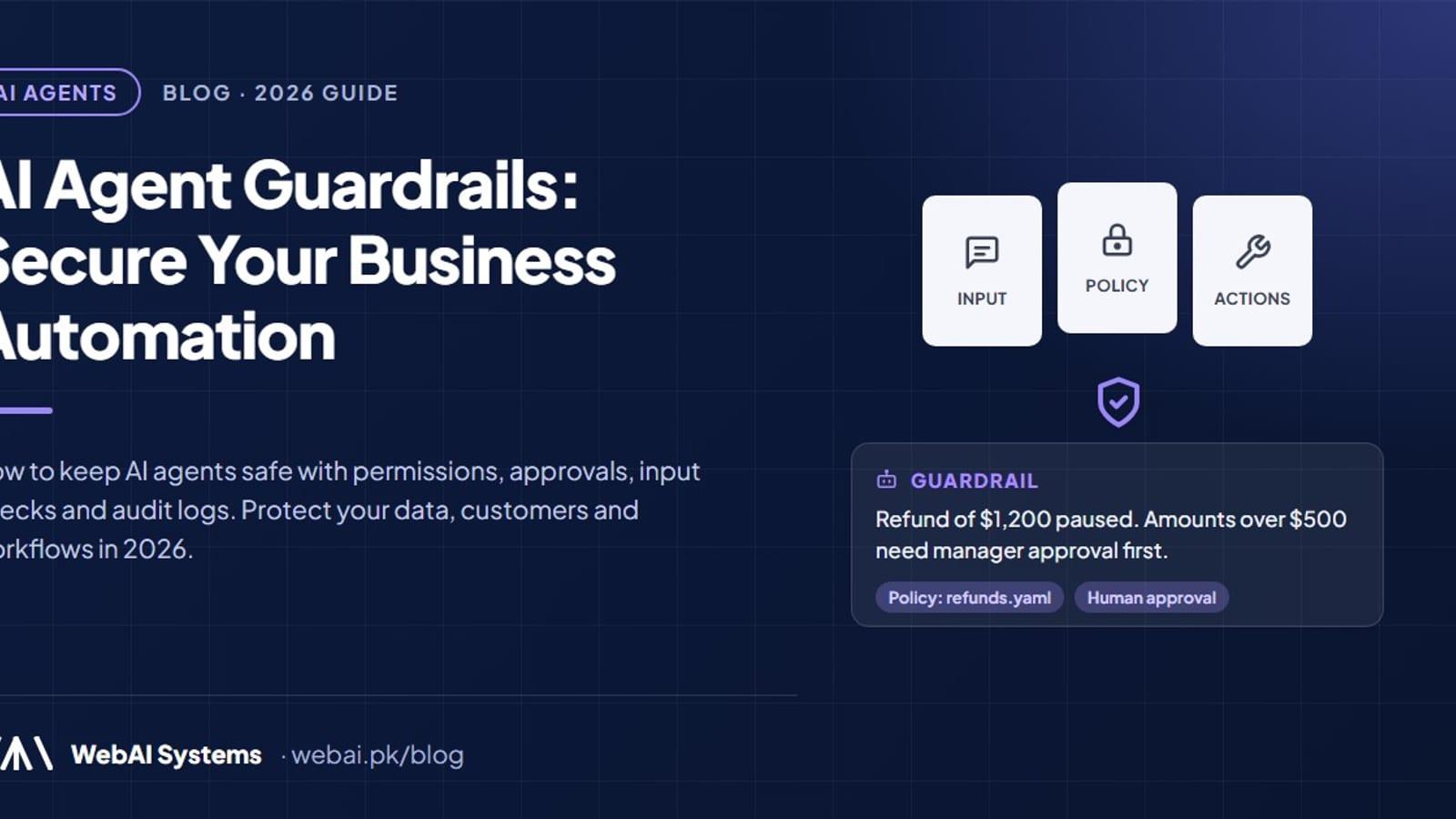
- Enforce AI Least Privilege Access: Never give an agent broad administrative rights. If an agent only needs to read product inventory, its API token should have strict read-only permissions for that specific table. It should never have access to user credentials or billing databases.
- Establish Human in the Loop AI Automation: For high-stakes actions—such as approving financial transactions, sending mass emails, or modifying production records—the agent must pause and request explicit human approval via Slack, WhatsApp, or a custom dashboard.
- Maintain Comprehensive AI Audit Logs for Business: Every prompt, system response, API call, and tool execution must be logged immutably. When an error or unexpected behavior occurs, your engineering team needs a clear audit trail to trace why the agent made a specific decision.
- Implement Input and Output Validation: Filter incoming user requests to block prompt injection patterns, and sanitize outgoing agent responses to ensure no sensitive internal data or API keys leak to the end user.
Enterprise AI Security Best Practices for Production
Moving an AI agent from a local sandbox environment into a live production setting requires rigorous testing and failsafes. Here is how leading engineering teams harden their deployments:
1. Define Clear System Prompts and Boundary Rules
Your base system instructions must explicitly state what the agent cannot do. While prompt constraints can sometimes be bypassed by sophisticated users, they form the first line of defense against accidental misuse. Combine these prompts with hardcoded backend validation layers that reject prohibited API payloads regardless of what the LLM requests.
2. Build an Instant Kill Switch
Every autonomous system must have an easily accessible master kill switch. If an agent begins behaving erratically—such as sending duplicate automated messages or flooding an external API—an administrator must be able to instantly halt all agent execution with a single click or automated circuit breaker.
3. Rate Limiting and Cost Controls
Autonomous loops can sometimes get stuck making recursive API calls or generating infinite text. Implement strict token limits, execution time-outs, and financial caps per session to protect your business from runaway cloud computing bills and denial-of-service scenarios.
Securing Custom AI and ERP Integrations in Pakistan
Organizations in Lahore, Karachi, Islamabad, and international markets are increasingly integrating AI agents with local ERPs, CRM platforms, and WhatsApp business APIs. When custom software handles proprietary financial data or localized supply chains, security is paramount.
Building secure automation means anticipating failure modes before they happen. By combining strict permission boundaries, continuous monitoring, and human oversight, you can harness the incredible productivity gains of autonomous systems without exposing your enterprise to catastrophic risk.
Conclusion
Autonomous technology offers a massive competitive advantage, but speed must never compromise security. By deploying robust guardrails, enforcing strict access controls, and maintaining complete visibility through detailed audit logs, your business can scale its automation safely. Ready to secure your enterprise AI workflows? Contact WebAI Systems today to design and build custom, secure AI agents tailored to your business infrastructure.
- #ai security
- #ai agent guardrails
- #automation
- #enterprise ai
- #rag
- #erp