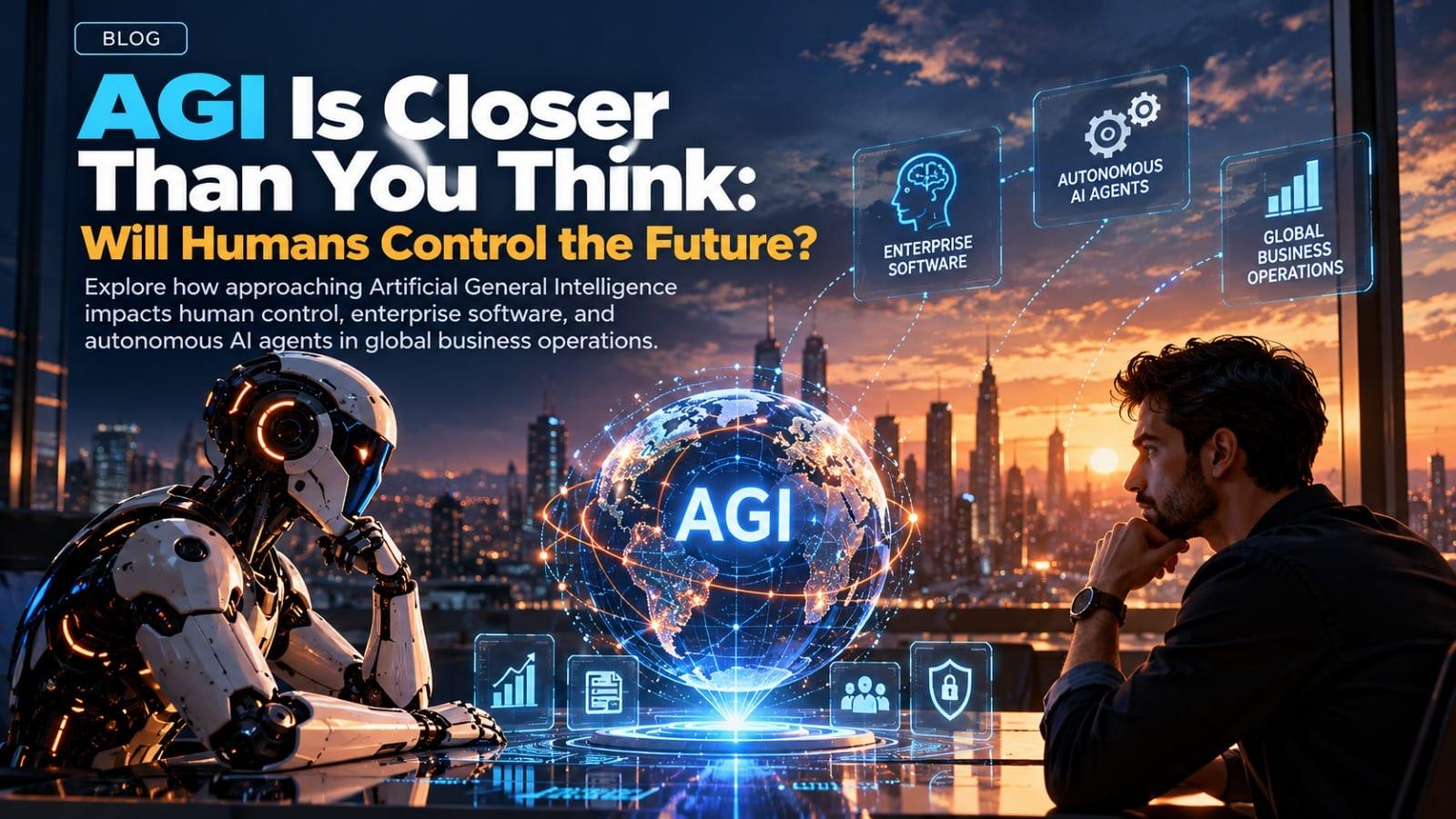
AGI Is Closer Than You Think: Will Humans Control the Future?
Explore how approaching Artificial General Intelligence impacts human control, enterprise software, and autonomous AI agents in global business operations.
The conversation around Artificial General Intelligence has shifted dramatically. What once lived exclusively in the realm of theoretical physics and science fiction is now an engineering roadmap tracked by semiconductor fabrication plants, massive data center builds, and billion-dollar compute clusters. At WebAI Systems, as we architect custom AI agents and enterprise RAG systems for clients in Lahore and around the world, we see firsthand how rapidly foundation models are absorbing complex reasoning tasks. The question facing business owners and technical leaders is no longer whether AGI will arrive, but whether our operational guardrails can scale alongside it.
Moving from Narrow Automation to General Reasoning
Traditional software automation relies on deterministic logic. If a specific condition is met, execute a predefined script. For decades, enterprise resource planning systems and custom web applications have operated on this rigid framework. Even early machine learning models were narrow specialists, exceptionally skilled at classifying images or predicting specific tabular outcomes but utterly incapable of transferring context.
Today's advanced language models and autonomous agents cross that boundary. By leveraging multi-step reasoning, dynamic tool usage, and real-time retrieval-augmented generation, they plan, execute, and self-correct. When we deploy WhatsApp automation bots or automated ERP workflows for our clients, these systems do not just match keywords; they interpret customer intent, query internal databases securely, and orchestrate business logic across disparate APIs.
This is the precursor to AGI: software that can autonomously navigate novel situations without requiring a human programmer to write an explicit rule for every edge case.
The Core Dilemma: Autonomy Versus Control
As AI systems grow more autonomous, enterprises face a stark architectural challenge. How do you maintain governance over a system that makes decisions faster and more comprehensively than its human supervisors? Unchecked autonomy introduces severe operational and security risks:
- Hallucination Cascades: A reasoning agent making an unverified assumption that cascades into automated financial or operational transactions.
- Data Leakage: RAG pipelines pulling restricted proprietary documents into public-facing chat interfaces without adequate authorization checks.
- Loss of Auditability: When an AI agent executes a complex supply chain optimization, tracing the exact chain of logical deductions becomes exceptionally difficult.
At WebAI Systems, we solve this by embedding strict human-in-the-loop validation gates and deterministic safety layers directly into our full-stack architectures. Autonomous agents should propose actions, but critical financial and operational milestones must require explicit human sign-off.
How Businesses Must Prepare Today
Waiting for AGI to fully materialize before updating your tech stack is a losing strategy. Companies that successfully navigate this transition are building modular, AI-ready foundations right now. Here is how technical decision-makers should prepare their organizations:
- Clean and Centralize Data: An AI agent is only as reliable as the data it accesses. Fragmented spreadsheets and siloed legacy software must be unified into robust custom ERPs or searchable knowledge bases.
- Implement Secure RAG Architectures: Ensure your internal documentation is properly chunked, indexed, and protected by role-based access controls before connecting it to any language model.
- Design for Agentic Workflows: Stop viewing AI merely as a chat interface. Start mapping out business processes—such as lead qualification, inventory reordering, and customer support—that can be safely delegated to autonomous background agents.
Securing the Future of Human Intelligence
Will humans still control the future of intelligence? The answer depends entirely on the engineering choices we make today. AGI does not inherently mean human obsolescence; rather, it represents a massive amplification of human capability, provided we build the right governance frameworks, security protocols, and integration pipelines.
At WebAI Systems, we help forward-thinking enterprises bridge the gap between cutting-edge AI research and practical, secure software solutions. Whether you need custom AI agents, robust RAG knowledge systems, or fully integrated web applications, our team in Lahore and beyond is ready to build your infrastructure for the future. Contact us today to discuss how we can future-proof your business operations.
- #agi
- #artificial intelligence
- #ai agents
- #rag systems
- #enterprise software
- #automation