How Chatbots Automate Online Businesses at Scale
Discover how AI chatbots and conversational agents automate customer support, sales pipelines, and ERP workflows to cut operational costs for online businesses.
Running an online business today means competing on response time, operational velocity, and customer experience. When a potential buyer lands on an e-commerce storefront or sends a message over WhatsApp at midnight, they expect immediate clarity. If they wait two hours for a human agent to clock in, they have already purchased from a competitor. Conversational automation has evolved beyond the rigid, rule-based decision trees of the past decade; modern AI chatbots and autonomous agents execute complex business processes across customer acquisition, order fulfillment, and internal enterprise resource planning (ERP).
From Static Scripts to Autonomous AI Agents
Early chatbots operated on rigid keyword matching. If a user misspelled a query or framed an inquiry outside the scripted decision tree, the bot returned an error or broke down. Modern chatbots integrate large language models (LLMs) paired with Retrieval-Augmented Generation (RAG) and API tool-calling capabilities. Rather than simply echoing canned replies, modern systems understand context, query internal inventory databases in real time, and trigger operational workflows.
For an online retailer or service firm, this shift turns a chatbot into an operational employee. The bot can check stock counts, confirm delivery timelines from third-party logistics (3PL) partners, apply dynamic discount codes based on user purchase history, and update billing records without human intervention.
Automating the Customer Acquisition Funnel
Lead qualification consumes substantial sales overhead. In high-traffic businesses, human reps spend hours filtering out unqualified inquiries, answering basic pricing questions, and chasing uncommitted leads. Chatbots transform this top-of-funnel funnel friction through immediate, structured engagement.
- Instant Qualification: An incoming inquiry on a website or WhatsApp channel is greeted instantly. The AI agent asks targeted questions to identify budget, company size, timeline, and product fit.
- Automated Scheduling: For high-ticket B2B sales or custom services, qualified leads are directly routed to account executives via calendar integration, syncing meeting links and CRM notes automatically.
- Dynamic Up-Selling and Cross-Selling: By evaluating cart contents and customer browsing patterns, conversational bots can recommend complementary products, increasing average order value (AOV) organically.
Resolving E-Commerce Logistics and Post-Purchase Inquiries
Up to 70% of inbound e-commerce customer support requests center around repetitive transactional inquiries: "Where is my order?", "How do I exchange this item?", or "What payment methods do you accept?". Using human staff to manually copy and paste tracking links from shipping portals into customer chats is inefficient and expensive.
Custom chatbots integrate directly with your central inventory and courier APIs. When a customer inputs an order number or contacts the business from their registered phone number, the chatbot queries the shipping status, returns real-time tracking coordinates, and provides precise delivery estimates. If an exchange is requested, the bot initiates the return protocol in your warehouse management system, generates a shipping label, and notifies the fulfillment team—completely unassisted.
Omnichannel Dominance: The Power of WhatsApp Automation
In emerging and digital-first markets, including Pakistan, the Middle East, and parts of Europe, email open rates continue to decline while conversational commerce via messaging platforms accelerates. WhatsApp has become the primary point of contact between consumers and brands.
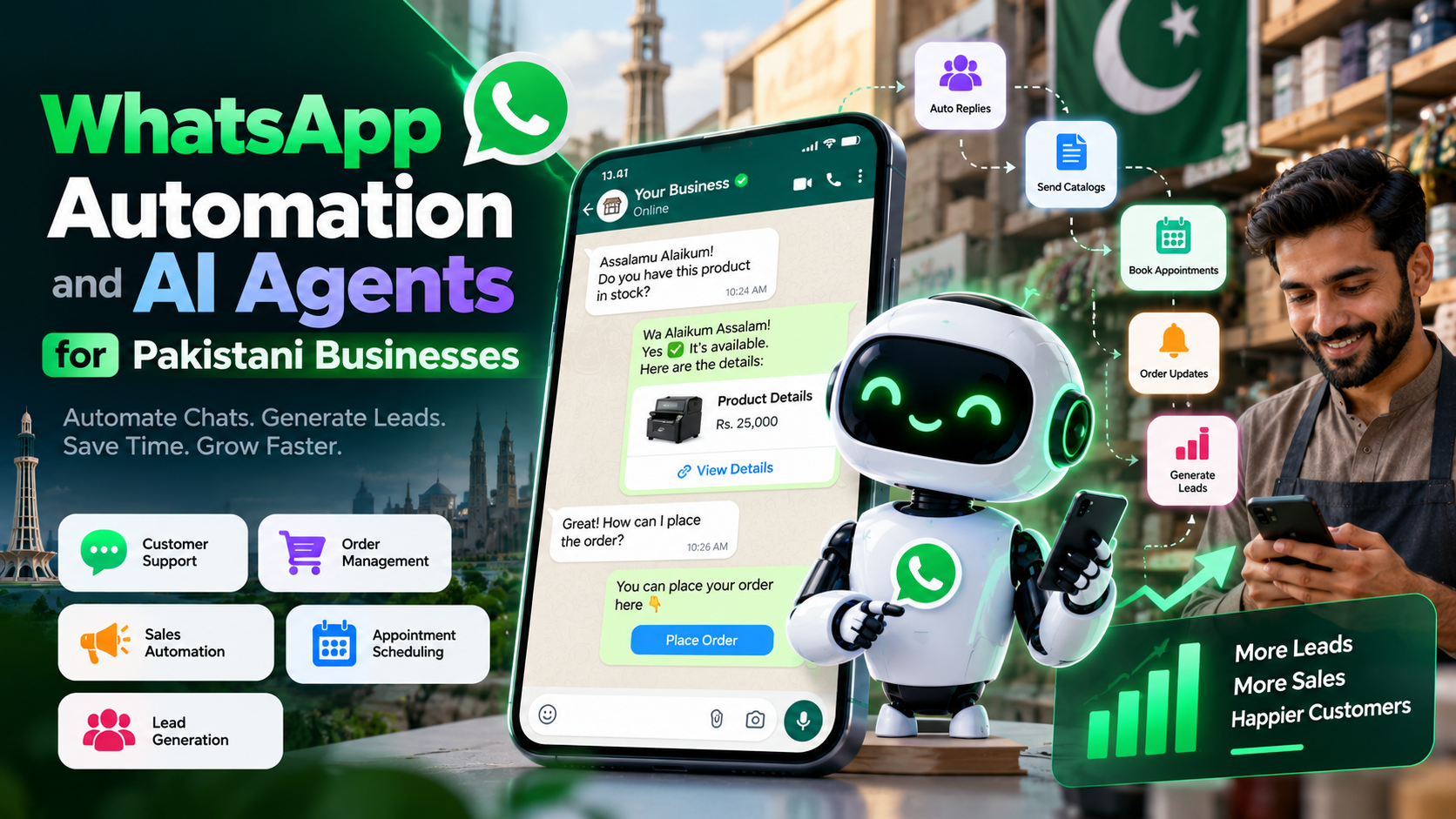
Deploying conversational AI over the official WhatsApp Business Platform enables an enterprise to manage marketing, transactional notifications, and customer resolution in one thread. Businesses can send automated abandoned-cart recovery prompts, deliver digital invoices with integrated checkout links, and collect post-purchase reviews. This direct line of communication delivers 80%+ open rates and significantly higher conversion velocity than traditional email marketing automation.
Integrating Conversational AI into Backend ERP and CRM
A chatbot's true enterprise value depends on what it is connected to. A standalone bot disconnected from backend software is merely a glorified FAQ page. High-performing deployments integrate directly with custom ERP systems, CRMs (such as HubSpot or Salesforce), and relational databases like PostgreSQL.
Consider an industrial parts supplier. When a commercial buyer asks for a bulk quote on 500 hydraulic valves, an integrated AI agent reads customer tiering from the ERP, calculates volume pricing and regional freight costs, verifies warehouse availability across regional hubs, and delivers a formal, downloadable PDF quote into the chat window in seconds. The bot creates an open quote ticket in the CRM and schedules automated follow-up sequences. This level of automated integration collapses days of manual administrative coordination into a few seconds of machine compute.
Managing Errors, Edge Cases, and Human Handoffs
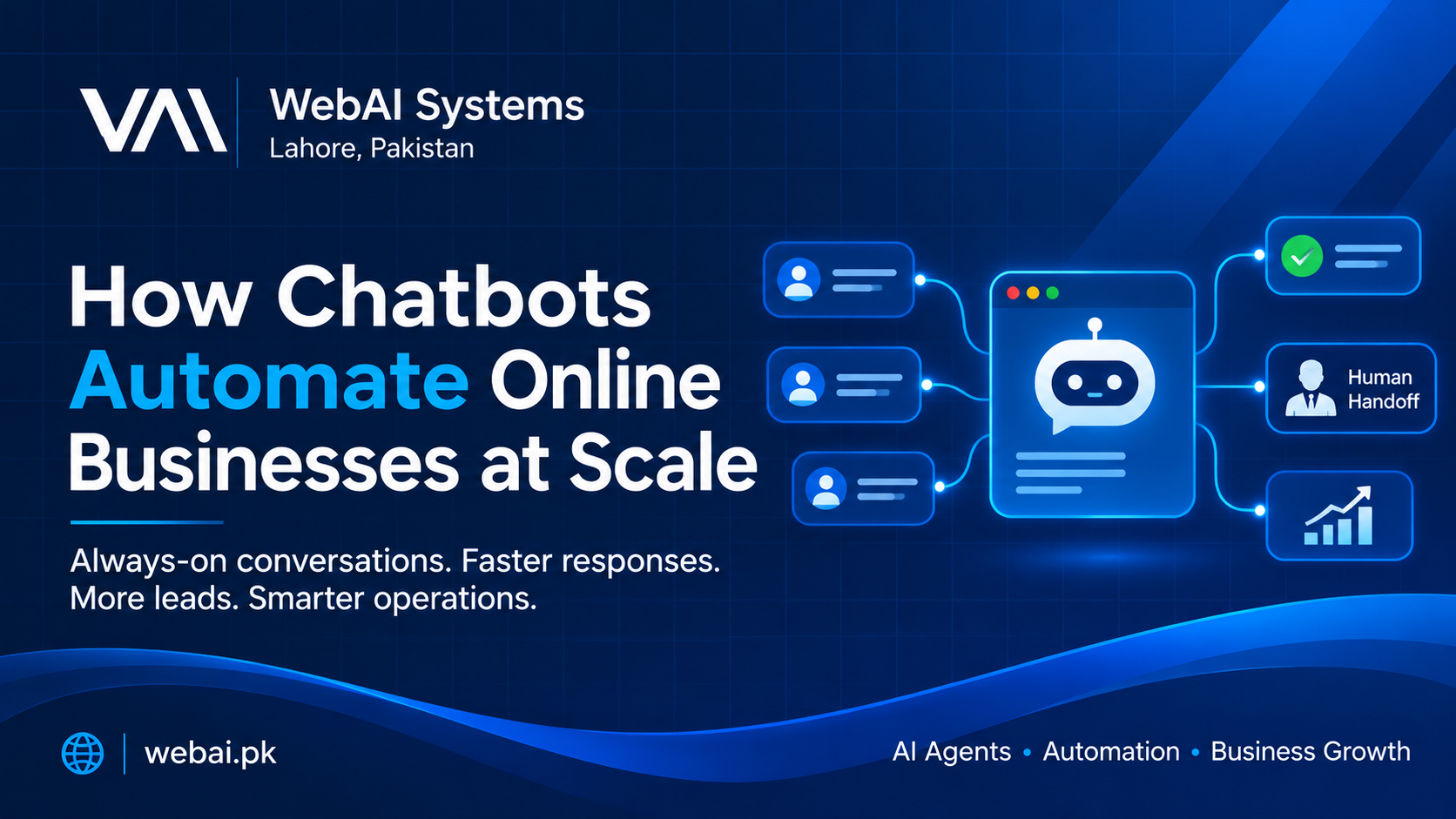
While AI handles the high-volume bulk of daily inquiries, edge cases and complex disputes require human judgment. An effective automated system must include robust fallback rules and seamless escalation mechanisms.
- Confidence Scoring: The underlying AI model evaluates its own response confidence based on retrieved source material. If the query falls outside verified knowledge parameters, the bot halts autonomous execution rather than guessing.
- Contextual Handoff: When transferring to a human specialist, the bot provides a concise summary of the issue, eliminating the frustrating customer experience of having to repeat their problem from scratch.
- Continuous Fine-Tuning: Unresolved edge cases are logged automatically. Business analysts use these logs to update the knowledge base, refine RAG document indexes, and expand system capabilities week over week.
Implementation Strategy for Online Businesses
Transitioning to conversational automation does not require overhauling your entire digital architecture overnight. A successful deployment follows three clear steps:
- Audit Repetitive Support Workflows: Identify the top ten inbound requests draining your team's daily hours. Typically, these involve order lookups, pricing sheets, product specifications, and return requests.
- Consolidate Knowledge Assets: Centralize documentation, policy PDFs, return guidelines, and product catalogs into structured formats to build a high-fidelity retrieval corpus for the AI model.
- Deploy and Iterate on Core Channels: Launch conversational agents on your highest-volume channels—such as web chat or WhatsApp—with deep API connections to your core business database, testing rigorously for accuracy before full public rollout.
Online businesses that automate customer-facing operations and backend fulfillment run lean, respond fast, and capture market share while traditional competitors struggle with growing support backlogs. WebAI Systems builds scalable AI agents, WhatsApp automation architectures, and custom enterprise software to turn operational bottlenecks into automated, revenue-generating engines.
- #chatbots
- #ai agents
- #whatsapp automation
- #ecommerce
- #erp integration
- #workflow automation